Market Mindfulness

Market Mindfulness #12: Staying on Top of Your Game during Market High Season

Managing a farmers market is hard work! As a market manager, you’re using a wide set of skills which draws upon your physical, cognitive, emotional, and psychological energies. As the season wears on and hits the busy peak of produce and customers, you’re frequently called upon to effectively manage a wide range of issues ranging from the minor, but annoying, to the true crisis. To effectively manage all of this, you need to have the energy and the physical, cognitive, emotional and psychological reserves for dealing with tense and fast-moving situations and to roll with whatever punches come your way. It may sound cliché, but you cannot pour water from empty cup.

This blog post will delve into strategies for taking care of yourself and effectively managing your market both throughout the rest of this season and in future seasons.

Strategies for taking care of you:

Self-care is often misconstrued as something that must take a long time (e.g. a week-long retreat) or be expensive (that hot stone massage) or must meet a certain “self-care” standard. The reality is that self-care is about what recharges you. If something that takes a long time or is expensive stresses you out, then it’s not recharging you. Choose something else. It could be taking a walk in the woods or around your farm. It could be saying “no” to something that you do not actually need to do and will only add stress. It could be getting together with a couple of friends to share a meal. Self-Care Bingo may help you think about self-care in a different way. If you think about the last week, can you get a bingo? If not, why? Was it an unusually stressful week? Are the items listed not activities which recharge you? Are you not taking care of yourself?

The reality is that there are only so many things that you can do during the season – particularly this time of the season as we’re all worn out and, in some cases, it’s just too late to implement something new. However, that doesn’t mean those ideas should be thrown out. Write them down, jot something in your phone’s note app, record a voice message to yourself. Do something to preserve that idea! Then, act on it. Some ideas for how to do this:

  • Make a plan to take better care of yourself next summer. What really drained you this summer? What irritated you the most? What recharged you the most? Step back and dig into these questions. Then use that information to make a self-care plan.
  • Figure out whether the item on your self-care plan is something that you can primarily do on your own or if you need to enlist the help of someone else.
  • If it is something you can primarily do on your own – exercise, drink more water, be tougher with the rules early in the season – give yourself plenty of time to develop your new self-care habit. According to the Lally study, it takes a while to turn an activity into a habit – generally 2-9 months depending on the person, activity, and circumstance. And, just because this is something you need to do primarily on your own, doesn’t mean you shouldn’t solicit some help. Maybe getting a walking buddy will help you stick to your routine. Maybe a whimsical water consumption app on your phone will help you drink more water. 
  • If it is something that will require assistance from others – maybe you didn’t get much help from your board, maybe you could have used a few days off, maybe different board members had different expectations and this caused confusion or way too much work – do your homework. Articulate the concern, figure out some possible solutions, build your argument, and then present it to the person or group who can make the change. There, of course, are no guarantees that this will work, but it definitely won’t if you don’t give it a try.


Strategies for market management:

Implementing new rules or new management strategies during the market high season in most cases, is not realistic. But that doesn’t mean there aren’t strategies you can employ to help you successfully get through the rest of the season. A primary strategy is to not beat yourself up over the small things and to manage both your own expectations for what you and others can accomplish and your own stress level. It is doubtful that many people, if any, will notice the extra signs that didn’t put up or the five minutes extra you took to linger over your coffee and breathe which made you a few minutes to the market. And, neither one of those is likely to have a significant impact on the market, so don’t let it have significant impact on you.


Other market management strategies for this and future seasons include:

  • Schedule volunteers during the busiest hours of the market. It may be easier to get folks to commit to a two-hour time slot than a whole morning and why not try to schedule them when you are the busiest?
  • Make certain to schedule volunteers to help clean-up from special events and not just to help set up or run those events. 
  • It is okay to put up a sign at the information table saying “be back in five minutes” so you can deal with a situation that needs your attention. Prioritize market needs and communicate the prioritization to the people demanding your time and attention.
  • Consider entering data directly into FM Tracks at the market if you have cell or data access. If not, make certain you have forms on which you can capture all the data you need for FM Tracks. Also, make certain to set aside time each week to do your data entry. This will ease the stress of getting everything ready by the monthly reimbursement request due date.
  • Do not fill market board vacancies during the summer, unless it is an emergency. This takes time and energy that can be used for market operations.
  • Consider using Zoom or other video/phone conferencing application to facilitate board member participation in meetings. Make certain all documents used during the meeting are available to all members, including those participating from a remote location. Having documents available via Google Docs or in a community storage area (such as Dropbox) are one way to do this.
  • Have clear market policies. This eliminates confusions and provides a tool for you to use in managing the market, particularly when conflicts arise over rules.
  • Involve your farmers in making decisions. This empowers them and helps to strengthen their buy-in to the market and its policies and can insulate the market manager some in tricky situations. For example, asking the existing farmers what they think about a guest vendor bringing a truckload of corn to sell at Saturday’s market instead of making the decision yourself.
  • Have a clear process for farmers who wish to join your market. It could be relatively simple such as a short application and verification of appropriate training such as PBPT or it could be more extensive such as a longer application, a farm visit, and a vote by the board of directors.
  • Note what happens during the market in a logbook, in an audio note, or some other manner. In the off season, use these notes to get your ducks in a row. Identify issues and trouble spots and possible solutions and then work with the appropriate people to implement the agreed upon solutions.
  • Create a market calendar that is available to all farmers so they know what is going on at the market.
  • Consider implementing a rule that farmers cannot politic about the market at the market (e.g. change the re-sale rule, change market times, etc.). Then, provide a time outside of the market for farmers to do so.
  • Schedule time to worry. A Penn State study found that people who schedule a time to worry – 15 to 30 minutes in the morning or evening – and then tabled their worry the rest of the time were able to increase their productivity.
  • BREATHE!!!


The good health of your farmers:

It’s also a chaotic, exhausting time of year for your farmers and they are also likely more stressed especially in years like this when the weather has been crazy and they may have taken a financial hit from crops not planted or destroyed or not producing as they should. Perhaps they get more easily frustrated this time of year or they are more difficult to work with. How can you help them?

  • Take some time to chat with them and ask how they are doing or how their farm is doing.
  • Take a step back when they seem to be difficult and ask yourself if the situation is being exacerbated by the farmer’s stress level, your stress level, or both.
  • Observe how they interact with the market and if there are changes in their behavior.
  • Offer resources, as appropriate, to vendors or as general practice to all market vendors:
  • KCARD (Kentucky Center for Agriculture and Rural Development). Provides educational opportunities, technical assistance, and business support services to new and existing agribusinesses. https://www.kcard.info
  • UK Extension Office. Provides informal education in agricultural production and environmental stewardship. http://extension.ca.uky.edu/
  • NRCS (Natural Resources and Conservation Services). Provides technical expertise and conservation planning for farmers, ranchers and forest landowners wanting to make conservation improvements to their land. https://www.nrcs.usda.gov/wps/portal/nrcs/site/ky/home/
  • Grow Appalachia. Provides gardening resource distribution and technical assistance, agricultural curriculum and hands-on training, high tunnel infrastructure and protected growing systems, and economic development and beginning farmer assistance. https://growappalachia.berea.edu


Looking for additional resources to help you manage your market? Check these out!

Market Mindfulness

Market Mindfulness Blog #11: Farmer’s Market Management Best Practices

by Kristen Coomer

One of the best and worst things about farmer’s markets in Kentucky is that they are not heavily regulated. This allows more creativity, but also a level of confusion for customers and vendors when there is a lack of consistency in how markets are organized and managed. So, how  do you build a “good” farmer’s market? This Blog and its accompanying Webinar will help Kentucky Farmer’s Market Managers to create a realistic and successful structure for their market in order to help it improve and grow over time.

Getting Started with Roles and Responsibilities

Setting up the market is the first responsibility you face throughout the day as a market manager. Setting up the info booth, making sure all signage is out, making sure the bathrooms are unlocked and in working order, setting out customer seating, and closing roads are all possible tasks you may have as a manager depending on your market’s location. Take time to thoroughly know your market space and realize where there might be problems like safety hazards (food safety, fire safety, tripping hazards, secured tents and tables), cleanliness issues or vendor spacing that could be improved. 

Once the market day begins, you become the face of the market. As manager, you will run the info booth as well as being involved with marketing, social media, customer engagement, incentive programs, the volunteer program, promotions and so much more. You will have the knowledge to answer most, if not all, questions about the market as well as being its biggest cheerleader. But don’t let this intimidate you, once you have a solid plan in place the market will begin to run like clockwork. 

(We also have several helpful resources at the bottom of this Blog to help you get started)

Know Thyself: SWOT Analysis 

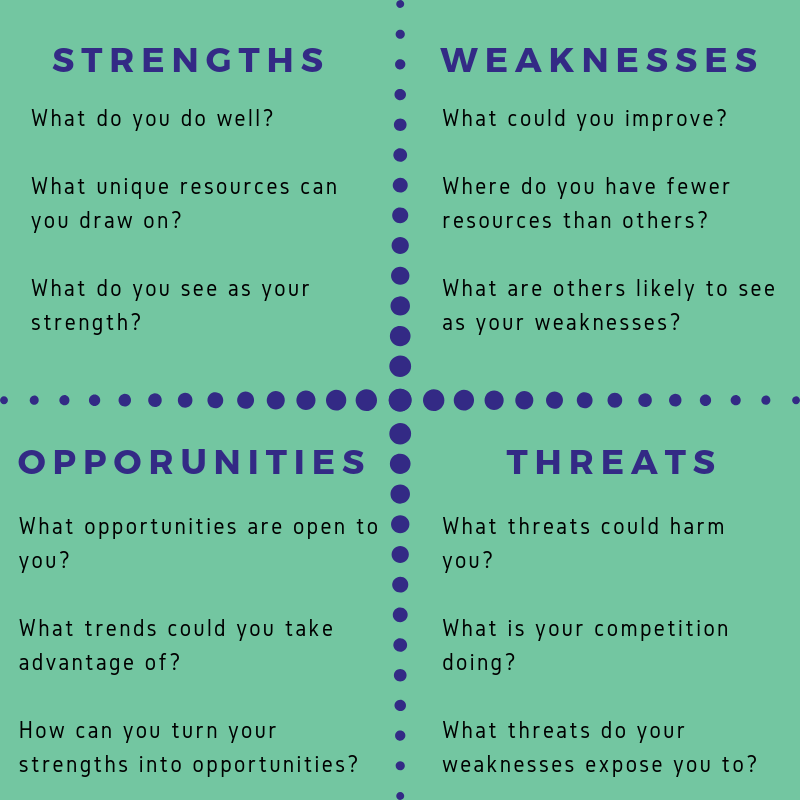
The first step in becoming the best market manager for your market begins with having a clear understanding of the market’s strengths, weaknesses, opportunities and threats.  Executing a SWOT analysis for the market and yourself can really pay dividends as well as assist you in developing a good, strong workplan.  

A SWOT analysis has two major sections:  Internal Considerations, and External Considerations.  Those sections are further broken down into (internal) Strengths, (internal) Weaknesses, (external) Opportunities, and (external) Threats (see the graphic below).  Consider what you as an individual AND the market as an entity bring to each of the four sections. A best practice we find it is most effective to be open and honest with the vendors and other market leaders with the market about your true work capacity, it doesn’t help anyone to overextend yourself and make mistakes because of it.  It’s important to take your time and really think this part out, as this is the foundation upon which you will build a great workplan!

Once you understand where you can improve or find support as manager, the next step is to look at opportunities and threats which are external to your market. Are there local businesses who would make good partners or sponsors? Does the market down the road have more diverse produce options? These are factors which may or may not be immediately obvious, but you will find over time. Keep coming back to the SWOT analysis when new information is presented. 

Once you have completed your SWOT analysis, use this information to determine how each factor impacts the others and what next steps need to be taken to address weaknesses and threats to the market as well as continuing to improve on opportunities and strengths. From here, you can make a roadmap complete with action items to get the ball rolling. Don’t be afraid to think long-term, planning for the season or even the year after can be extremely helpful even if you don’t follow that plan exactly. 

Drawing the Roadmap to Success

To get started, look at your top priorities for improving your market now. When doing this it is advised to involve other important voices from your market such as board members, vendors, volunteers, or community stakeholders who will bring different viewpoints and resources to the table. Some of the questions your market should be asking are: Does the market have the capacity to continue to grow? Should we find more people, or figure out how can you work to scale down? And more importantly how will this impact our customers and sales over time? 

Once you get started, the next step is to take the goals you created after your SWOT analysis and market discussion and apply calendar deadlines. Plan out who is involved and what needs to be done leading up to events or market changes. Remain realistic in your goals and keep others in the loop over time to ensure your season can progress with minimal bumps in the road. 

In order to make sure things are moving along at a proper pace, create performance goals to reach such as a specific number for Facebook likes, crowd counts or sales. Measurable factors such as customer counts and market sales can be valuable tools in determining where you are at in your market journey and showing growth over time. This way you can see whether you are reaching your goals along the way and if you need to tweak your plans.

Don’t be afraid to experiment with different ideas for events or social media, sometimes unlikely ideas can draw a lot of attention. Change things up from season to season to keep customers interested and bringing in more people, and remember, if things don’t work out then don’t do things that way again. It is never a failure to have tried something new and learned from it. 

Planning Your Journey from Point A to Point B

Once the bigger picture is a little bit clearer, it’s time to tune in on the finer details of your workplan. What do your day-to-day operations look like? How many hours will you be working a week outside of the market? Figure out what different to-do lists need to be completed every week. 

Find ways to create patterns in your work so that there can be a more developed structure for operating procedures on a weekly, monthly and yearly level. Keep records of everything you can over time, records not only are helpful for planning future growth but also for showing potential sponsors or community partners how your market has been organized over time. Also, try to make sure there are plans in place and someone is trained for days when you need a break, have an illness or wanting to take a vacation.

At the end of the year, compile your SWOT Analysis, Roadmap, records of measurables which were kept over the season, progress made, and photographs of the market, and put them all together in an annual report. See whether the goals you set in place were successful or if changed needed to be made to complete tasks. This report will serve as a template for planning for the next year as well as being useful, as mentioned above, to show off to potential investors. Don’t shy away from showing off your market or asking for money, you never know who a potential investor might be.

 If there were mistakes made or there were obvious shortcomings, take time internally to go over these instances and figure out how to avoid them in coming seasons. If you notice failures were due to a lack of commitment from certain people involved in the market, make sure to take time to talk to them about it. Knowing where your weaknesses are and knowing how to improve upon them can be one of the greatest strengths your market can have.

Best Practices and Fine Details


Once you have a plan made for the entire season, procedures in place on a daily, weekly, and monthly schedule, and ways to mark your progress along the way the final thing to look at is the nitty gritty work that happens during market hours.

One way to help you stay organized is a market box. If your market does not have designated storage space, getting a large tub is advised in order to hold the market’s supplies such as: 

  • office supplies 
  • banners
  • first aid kit
  • tent clips
  • tablecloths
  • tokens and vouchers
  • plastic bags
  • entertainment for kids
  • hazard tape
  • recipes
  • clipboard with the market’s rules and regulations


Other useful tools you may not think about could be a broom and dustpan, tent weights, traffic cones, extension cords, or even a fire extinguisher. Having all these items in one central location can make for quicker market setup and easier for any substitute manager.

Another thing to remember as a manger is self-care. Make sure you are staying hydrated and taking breaks when you need to and that you have plenty of shade throughout the day. Wear close-toed shoes to protect your feet from heavy objects or broken glass. If you are not operating at full capacity the market could suffer for it, so make sure to put your health first.

Discuss with vendors know how much they need to take home with them (depending on the permanency and security of the market space) and then make sure they are all breaking down their workspace fully and clean up after themselves before leaving. Make sure vendors do not begin breaking down their space until the market has officially ended, and customers have mostly left. This keeps the market space clean, lessens traffic congestion and be ready for the next market.

If it is an election year, make sure to create a space in the market for free speech and make sure not to give the appearance that the market endorses or has a stance against any political candidate. The market should be politically neutral as to not exclude any customers.

Always pick a specific time of day to collect measurables each week so that your records can stay consistent, which is important for accuracy over time.

Finally, make sure to give yourself a pat on the back. You are working hard to support local farmers and help provide fresh, local food to your community. That is something to be celebrated.


Below are several helpful resources for Market Managers through CFA or our partners:

CFA Farmers Market Toolkit: https://cfaky.org/2019-farmers-market-toolkit/

KY Farmers Market Managers Facebook Group: https://www.facebook.com/groups/726252390897377/

FMSP Google Group: https://groups.google.com/d/forum/cfa-fmsp

YouTube: https://www.youtube.com/channel/UC3zH4g8Z2bh8Tgz0QvlOP0A

Monday Market Matters Playlist: https://youtu.be/xs8FkagXeIM

See Also: Farmers Market Coalition Market Manager FAQ: https://farmersmarketcoalition.org/education/market-manager-faq/

Market Mindfulness

Market Mindfulness #10: Tell Your Market’s Story for National Farmers Market Week

WHAT IS NATIONAL FARMERS MARKET WEEK?

National Farmers Market Week (NFMW) is a week-long celebration of farmers markets sponsored by the United States Department of Agriculture (USDA) to raise awareness about the impact farmers markets have on local communities. It’s the perfect week to highlight what makes your market an important part of your community.

WHAT’S YOUR FARMERS MARKET’S STORY?

The story of your farmers market tells customers how visiting your market is a unique shopping experience. Your market has many different story lines but try to focus one way that sets it apart from other food retailers.  Is it a family friendly, community gathering space? Do you want to highlight food accessibility for all?  How about telling how your farmers market impacts your community’s health or local economy?

Once you have your story, talk to customers, farmers and board members to get personal reflections about the theme. Is there a family that regularly comes to the market? A senior who is willing to share how the market gives them access to more fresh produce? A farmer who can share the economic impact of the market on their farm?  You’ll use these vignettes in your advertising, press releases and other promotions for the markets. And don’t forget to snap a few photos of the story tellers.

For more help in creating your farmers market story, check out our webinar “Finding Your Brand” that walks you through the steps of how to differentiate your market from other food retailers.

WHAT’S YOUR BUDGET?

You don’t have to deplete your bank account to put on an enjoyable celebration but you certainly want to set up a budget before you launch your plan. Here are some possible things to include in your budget:

  • Employee wages to organize the event
  • Food
  • Music
  • Supplies for activities
  • Advertising
  • Signage

This is a great time to ask a local bank or business to sponsor your event.  In exchange for a donation of money, goods and/or services, you can advertise their business or organization by creating a banner with their name and logo, advertising on your website or giving a shout-out on social media. If sponsorship is new to you, check out our “Creating Community Partners” webinar that will teach you how to build partnerships and sponsorships in your community.

INVITE COMMUNITY LEADERS

Who needs to know your story or what leaders are champions of it? Invite them to your event to engage their support for your market. Think about key elected officials who represent your town or district, business groups like the Chamber of Commerce, public health leaders from your health department, local clinics or local hospital, or food access organizations like your local food bank and your Cooperative Extension staff.

Invite community leaders who are already champions of your market to help you tell your story. Their support of your market may encourage community members to give your market a try. Work with these leaders to reach other leaders who you want to engage in and support your market. For example, your mayor who is supportive of your market may be the perfect person to talk with your state representative about the economic benefits your farmers market brings to the community and why, as an elected official, it is important to support it.

Be ready with some fact sheets about your market to distribute to these leaders and your customers. These will give your champion leaders data to support their story about your market and other leaders and customers the opportunity to understand the depth and breadth of the market. This is where FM Tracks is helpful to pull reports for your market’s SNAP/EBT, Senior and WIC sales numbers. Also include data like annual farmers market sales and number of producers served. If you are illustrating your family friendliness, list activities, programs and/or special events you sponsor. Similarly, if you are focusing on health impacts, list your area’s health challenges and how fresh local food leads to positive health outcomes.  Piktochart  offers free, on-line design software to help you create an infograph, report or poster for a snazzy visual display of your market’s story.  The Farmers Market Coalition (FMC) put together a “Farmers Market Facts” sheet with talking points and national data about the impact of farmers markets on a community’s economy, health, soil conservation and farm education.

If you need help getting  emboldened to invite your state or federal legislator, check out this this  video series from the Farmers Market Coalition (FMC), “Meeting with Elected Officials About Farmers Markets Week” .

PLAN SPECIAL EVENTS

Think about how you can use the event to more deeply engage your customers in your market’s story. To illustrate the economic impact of farmers market vendors on the community, each vendor could post a flyer that lists the businesses they regularly use to operate their business.  If it’s healthy living you’re illustrating, offer cooking demos, health screenings, a breast feeding booth and other wellness related activities. For a family-friendly story, offer kid friendly activities like a scavenger hunt, face painting, a petting zoo, crafts and/or “Kids Bucks” they can spend at the market.  Day care centers and youth groups may be helpful resources to run child-centered activities.

ENGAGE THE MEDIA

Press Release: Use your local newspaper, radio station, local access cable or T.V. station to get your story out to the greater community at no financial cost to your market.  A press release to several media sources is a quick way to hit a lot of different outlets. The outlets can choose to pick up the story or not but, especially if you’re in a more rural area, local media is often looking for public-interest content. To make it easy, Community Farm Alliance created an easy-to-use, press release template <upload to website and link here> you can modify to fit the needs of your market. Be sure to include the quotes and photos you collected from producers, market leaders or customers when you were crafting your farmers market story!

Op-Ed:  Unlike a general press release where you give general information about your market and the news outlet crafts the details of the final story, writing an op-ed gives you creative control on how your market’s story is told. Like a press release, there is no cost to posting an op-ed but you will be limited on the word count. Contact the editor of your local newspaper to find out specific op-ed requirements.

Advertise:   Although free, a press release or op-ed does not guarantee that your market’s event will be covered. Purchasing an ad from your local news or entertainment outlets is a sure way that your event will be publicized. To get more bang for your buck, Facebook offers affordable advertising which targets the population that is most likely to shop at your market. To help you create an effective ad campaign, CFA will be hosting a webinar on July 8th
“Getting More Bang for Your Buck through Facebook  Advertising”   to give you the tools you need to create an effective ad campaign. After the airing date, the webinar will be recorded and uploaded to our “Monday Market Matters” YouTube channel to view at your convenience.

HOW IS COMMUNITY FARM ALLIANCE SUPPORTING LOCAL FARMERS MARKETS DURING NFMW?

We want National Farmers Market Week to be a smashing success in Kentucky so we are hosting a press event with state agencies and community partners around the state. We will be launching a Facebook ad campaign to direct customers to their nearest Farmers Market Support Program (FMSP) farmers market. We are also hosting CFA Days at some FMSP markets to personally thank farmers for growing our food and customers for supporting their farmers market. Contact your FMSP technical assistant to set up a CFA Day at your market. And, as mentioned above, we created a press release template <upload to website and link here>  and are hosting a FB advertising webinar <register here> to help you create the advertising you need to make your farmers market celebration a success.

OTHER NFMW RESOURCES:

Farmers Market Coalition has created a NFMW resource and template page that will take a lot of the work out of advertising and hosting a NFMW celebration.

The United States Department of Agriculture has created eye-catching graphics that are easy to use. You can use their designs or create some of you own using their ag-related alphabet letters featuring the sights and sounds of farmers markets.


Additionally, here is the 2019 National Farmers Market Week Press Release Template

How your farmers market can use the press release:

1] Remove yellow highlights. Here’s a helpful link if you have trouble.

2] Save document as a PDF by clicking “Save as PDF” in the “File” menu.

3] Use it by:

  • Sending it to your local media (newspaper, radio station, local access cable, etc.)
  • Posting it in your market’s newsletter
  • Sharing it with your partner organizations and/or sponsors
  • Sharing it with anyone else that can help you get the word out
Market Mindfulness

Market Mindfulness #9:The Importance of Collecting Daily Vendor Sales

By: Jennifer Weeber and Margie Stelzer, Farmers Market Support Program Technical Assistants


All markets participating in our FMSP and KDD grant programs are required to collect and report vendor sales data for their market. Vendors sometimes are reluctant to share that information because of concerns about vendor privacy and market managers are at a loss with how to collect that information. But, collecting vendor sales data is helpful to your market in so many ways, and, your vendors are ultimately the benefactors of such data which can be used to increase their sales


How to ease vendors’ reluctance:

  1. Share the positive effects collecting sales data could have on your market
  • Market Assessment: Vendor sales data gives the board important information about market operations. For instance, if you have a special event, you can evaluate what kind of impact that event had on sales to help you refine how you host the event in the future.
  • Community Support: You can use sales data to show the impact that your market has upon the local economy. This is especially helpful when approaching civic or governmental organization to ask for their support.
  • Grants: Vendor sales data is often needed when applying for grants for your market. Grants are awarded to help your vendors expand their sales, so you’ll need to prove that the grant had a positive effect on those sales.
  1. Make it Anonymous: Vendor slips can be handed to each vendor who then place it into a box, envelop or other receptacle at the end of the day, week, month or season. The vendors’ name is not on the slip so it cannot be traced back to them and the receptacle keeps other venders from viewing their sales data.
  2. Make it a requirement of the market: Let vendors know early in the season that sharing sales data will be done discretely and anonymously but will be required for every participating vendor. Most markets report that after getting over the hurdle of initiating a requirement to report sales, that almost all vendors comply with the regulation. As more markets across Kentucky require sales, it is becoming common practice and more normalized.
  3. Build gathering vendor sales data into the routine of your market: Just as you likely have a certain time for vendors to set up and care for other tasks within the market, make certain to set aside a time for sales data to be gathered. For example, you could have vendors do daily reporting as part of their cleaning up and checking out of the market or you could have vendors turn in vendor slips at the beginning market of each week for the previous week’s sales. Think about what will work best into the flow of your market.
  4. Engage your vendors in developing your sales data collection system: Creating a space in which your vendors can share their concerns and then work together to resolve their collective concerns can create trust in the system as well as buy-in from reluctant vendors. It also is a way for you, as the market manager, to identify and address issues up front that you may have not considered.
  5. Offer flexibility in your system/Be flexible: Figure out if there is any flexibility which you can offer to your vendors in how sales data is reported. For example, if using anonymous vendor slips, allow a vendor who is more concerned about another piece of paper to fill out than anonymity to tell the market manager his/her sales directly. Also, if the system you set up ends up not meeting your needs, be open to adjusting it. It may be helpful for your vendors to know going into sales data collection that there is some flexibility to make adjustments to better meet the needs of the market and vendors.


Once you begin to collect data, share that information back out to your vendors to show them the value of the data. If you collect daily sales, let them know what the peak sales day was the previous month and if that correlated with any special event. As you do your winter planning for the next season, use sales data to help the market schedule events to maximize sales. By combining your data from KDD with your market sales data, you can show the impact of the grant on the market.


Click Here for a few examples that other markets have used that could be useful for tracking your market sales. Please reach out to the CFA Farmers Market Support Team if we can be of further assistance to you. Good luck in your sales data collection adventures!

Market Mindfulness

Market Mindfulness #8: Wanted: Farmers Market Vendors!

By Jennifer Weeber, Northfork Local Food Coordinator

Close your eyes and imagine your ideal farmers market. What do you see? How does that differ from your current market? If one of those differences is more vendors who offer a broader range of products, this blog is for you. While there is not a magic formula for vendor recruitment and it is a challenging task, developing a vendor recruitment plan for your market can increase the likelihood that your efforts will be successful. The following are some tips on creating that plan:

Know your market.

Do you need more vendors? Do you need larger quantities of products that are already sold at your market? Do you need different types of products? Do you need all of the above? What do your customers want? With this information in hand, you can figure out your actual gaps and begin to identify the type of vendors you need. Before going to the work of recruiting, though, talk with your current vendors. Are any of them willing and able to expand the quantity or type of their offerings? If so, you are helping your vendors grow their own businesses while you are growing the market.

Anticipate your customers’ buying habits.

In an ideal scenario, everyone you recruit to your market will make money immediately and never leave ever again! BUT that isn’t how this works, is it? When it comes to actively recruiting, you’re going to need to focus your energy on items you know your customers will buy.  Spending your time recruiting a pate vendor for your market, when you know that there are only five or six regulars who might be interested in buying it is not time well spent. Pay attention to what is already there and would be complimentary to that. OR what has long been popular but sells out faster than it can grow!

Get prepared.

Why should a vendor sell at your market? Before attempting to recruit new vendors, you should be able to concisely answer this question. Your answer should be unique to your market and flexible enough to be targeted to the type of vendor you are recruiting (e.g. vegetable farmer, baker, meat producer). It may include information about your market’s mission, what benefits are available to market members, gross sales your market generates, and why you are interested in them and their products (e.g. We have a customer demand for yeasted breads that we cannot currently meet and several people have recommended you as excellent baker.).

What sort of informational materials do you need? A one-page flyer or a rack card which promotes your market to potential vendors may be a powerful tool which can be used in your recruiting efforts. This should provide basic information about the market, why vendors would want to sell at your market, and what they should do if they are interested.

A packet of information should be readily available for potential vendors who indicate an interest in your market. This packet should contain information on the market such as days and times of operation and the set-up process, vendor requirements such as permits, training, and insurance, payment methods and programs such as SNAP and Kentucky Double Dollars, vendor fees, and any other relevant information along with a copy of the market rules and a vendor application.

Find vendors.

Where in your community do the type of vendors you wish to recruit hang out? Who may have access to them? Some ideas to get you started are listed below:

  • Talk with your current vendors
  • County Extension offices (http://extension.ca.uky.edu/)
  • Farm Service Agencies (https://www.fsa.usda.gov/state-offices/Kentucky/index)
  • Kentucky Department of Agriculture (http://www.kyagr.com/)
  • Natural Resources and Conservation Service (https://www.nrcs.usda.gov/wps/portal/nrcs/site/ky/home/)
  • Agriculture classes and programs at Big Sandy, Elizabethtown, Henderson, Madisonville, Maysville, Owensboro, and Southcentral Community and Technical Colleges (kctcs.edu)
  • Farm supply stores
  • Winter agricultural workshops
  • High school agriculture and consumer science programs
  • Future Farmers of America
  • Producer organizations (farmer, baker, arts and crafts)
  • Beginning, urban, or refugee farming programs
  • Gardening clubs
  • Churches
  • Roadside stands and restaurants and retailers selling local foods
  • Social media groups
  • Community Farm Alliance’s Farm to Table Team

Figure out the messenger.

Who is the right person to ask a potential vendor about joining your market? Think about who you are trying to recruit and in what setting. It may be the market manager. Or, it could be another vendor, a market volunteer, a board member, or someone else. It could be a tag team effort with a volunteer making the initial contact and then introducing the potential vendor to the market manager for additional information.

Support your vendors.

What help do new vendors need to be successful at your market? New vendors may need help with pricing, setting up their booth to be visually appealing, customer service, or some other skill. There may be language barriers between the vendors and customers. Talk with your new vendors about what they need. Observe how they are doing. Your attention to them will help to create regular vendors for the market as well as to help them grow their own businesses.

How can you support your established vendors so that they remain with your market and continue to be successful? Talk with them about what they need. Observe how they are doing. Match established vendors with new vendors to provide mentoring. This can help established vendors to develop their leadership skills and new vendors to integrate into the social network of the market.

Grow your vendors.

It may be that there is no one in your community who is producing the products at the scale you need for your market. In that case, think about how you can grow some vendors. Are there some gardeners who always have a little excess produce? Is there someone who always makes delicious cookies and breads for the school bake sale? Perhaps they would be willing to try out the market a time or two. If things go well for them, to what resources can you connect them to help them produce enough to regularly sell at the market?

You can also start growing the next generation of vendors by encouraging youth to participate in your market. Consider hosting “youth vendor” days or having a “junior vendor” application. Use of a booth or the annual membership is offered at a reduced price or is even free to give the youth the opportunity to try out the market and gain new skills. Be prepared to spend extra time in helping your young vendors figure out pricing, their display, and other marketing aspects. Pairing each youth with an established vendor can reduce the tensions that can come with new sales competition and provide the youth with mentoring which can help them hone their agriculture and marketing skills.

Dig into additional resources.

A variety of resources exist to help you think more about how you can successfully recruit vendors. Here are few to get you started:

Reach out to CFA.

Please reach out to the CFA Farmers Market Support Team if we can be of further assistance to you. Good luck in your vendor recruiting adventures!