By Ly Madden, Perry County Community Ambassador
“That’s what God created on the eighth day, was a garden.”
 Pictured are Ron, left, and Garnet, right, eating a plate of garden-grown veggies on their porch.
My old neighbor, Ron Weddington, is clearly goading his mother, Garnet, with that line. She’s on the porch with us, so he only gets away with his joke long enough to elaborate on that first line: On the 8th day God created gardeners to take care of all his bounty here on Earth. He can’t catch it sitting next to her, but she gives him the long eye that time, before she cuts in:
“Now where’d you get that? In the scriptures?”
“Well I just made it up Mom!”
“You don’t do that!”
He should know better, too. Earlier that night, when Garnet described the routine her family of eleven siblings and their parents followed on a seven-acre farm in Floyd County she was raised on, the only break from the daylight-to-dark shifts were their Sundays. “We never had to work on a Sunday, never. That was our day,” she says.

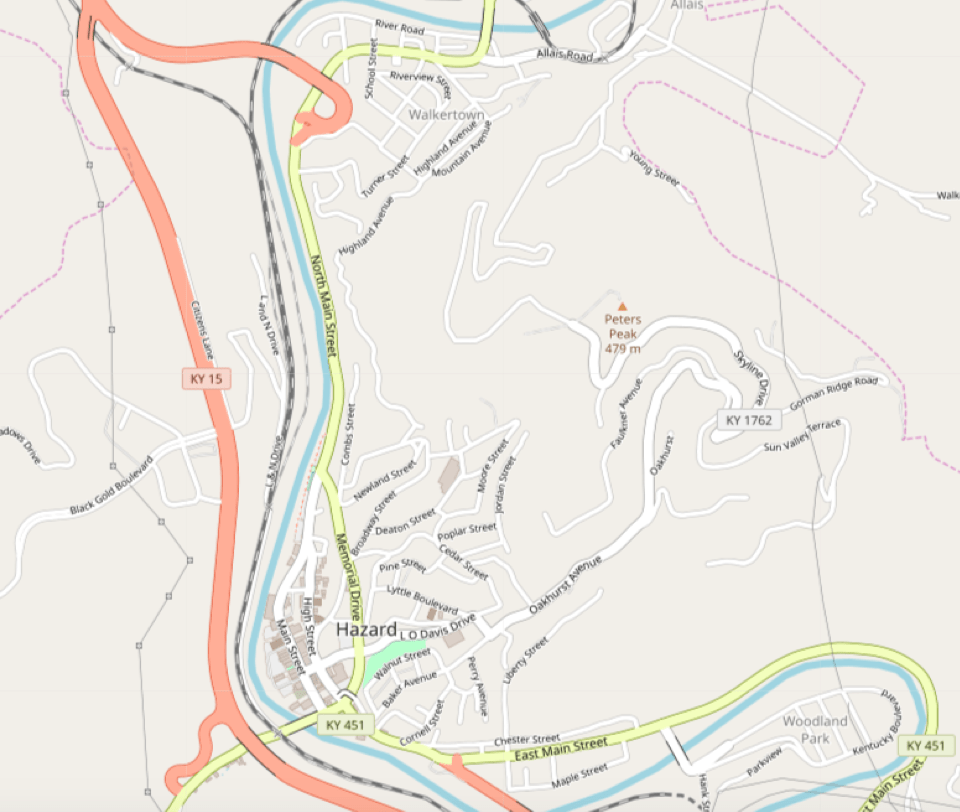
Pictured are four neighborhoods of Hazard: Woodland Park; downtown Hazard between the North Fork of the Kentucky River and Memorial Drive; the Backwoods to the East of Memorial Drive; and Walkertown to the North.
The seven-acre farm’s gone, but the Weddingtons have held onto to a two-plot garden in the heart of Hazard. Ron and his wife, Tammy, live with their son in the house next door to Garnet’s in Walkertown, the next neighborhood upriver from downtown Hazard. Tammy grew up in Rowdy, close to the Breathitt and Knott county lines and relatively far into Perry County, while Ron and Garnet have lived in Walkertown nearly their entire lives. Their homes share a yard, threaded through with a laundry line, and bookended by the strip of Main Street running through the heart of Walkertown on one side, and the Kentucky River on the other. Late at night in July, the insects are loud enough to crowd out the sound of cars exiting and entering Highway 15 a few blocks south.
5,000 or-so folks lived in Hazard at last count, a small town to most, with 5,000 or-so people that will tell you they live in a neighborhood within a city. Names for each neighborhood are popularly interpreted in a few of their origins – the Backwoods traces its name to platting books drawn around the time of campfire revivals, while Jenny Williams has told me a diary written in the same period gives a few blocks of that neighborhood a separate name, worth considering for historical accuracy in our local naming system. Walkertown and a handful of other neighborhoods kept the names they held before their incorporation into Hazard City limits. Along the Kentucky River, the City boundary crept outward first to Walkertown, and runs the length of two to three hours in boat-on the-water time to Airport Gardens, the last neighborhood before one leaves town.
The chain of distinct neighborhoods always gave Hazard the feel of a bigger city, where Walkertown sits neatly between tight-knit and-quiet and a close walk to downtown. Yards lean on the city side, smaller and close together, and while the weather is pleasant enough for folks to manage herbs and tomato plants in the backyard, within city limits one can be hard pressed to see the land for farming.
Still, Ron’s father, Bert, began a garden on the banks of the Kentucky River in the 1970s. It’s a garden Ron and Tammy still maintain, and a project Garnet’s always shepherded along. “I do everything that mom taught me to do,” Ron told me. “And the seed that we’re using, our green bean seed, that came from my great-grandmother, that I still raise today.”
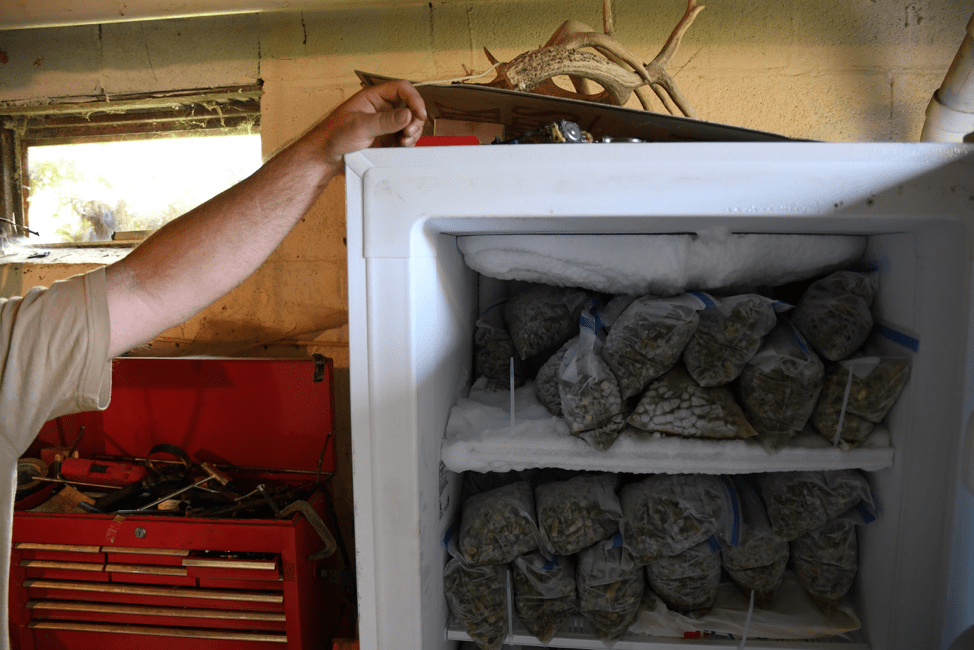
 Pictured are a few shelves of this year’s yield of green beans, the same passed down from Ron’s great-grandmother.
In Perry County, gardening’s popularity has waned within Hazard over Ron and Tammy’s lives. Out in Rowdy, where there’s wider parcels of land to live on and grocery stores are further away, Tammy’s grandmother raised a garden that could feed her entire family that she and her siblings helped tend, a practice that remained common outside of county seats.
“And I hated it!” Tammy says, ending with a laugh. “But now we do it a little bit different, and it’s a lot easier. I enjoy it today. And it’s not so – like, it was taboo when we were growing up. Only the poor kids had to work in their gardens, and make sure they had a big garden, cause they couldn’t afford to go to the grocery store and buy their food. So [growing up] we hated it, but I really, looking back I appreciate it, and I could always go to my grandmother’s, and she would always have food, always. And it was good food.”
Despite the decline in home gardening within county seats, Garnet, Tammy, and Ron have maintained the Walkertown garden behind Garnet’s home. So far this year, their yield’s held up, with their garden growing beans, corn, cabbage, onions, cucumbers, tomatoes, potatoes, and kale. At this point, they’re waiting on a second crop of corn, sweet potatoes, and watermelon. In the truck shelter next to Garnet’s house, bunches of onions are tied to the beams, along the porch, the railing is lined with tomatoes. From everything I see and hear, it looks like a good year for the garden; still, Ron insists on changes for next year.

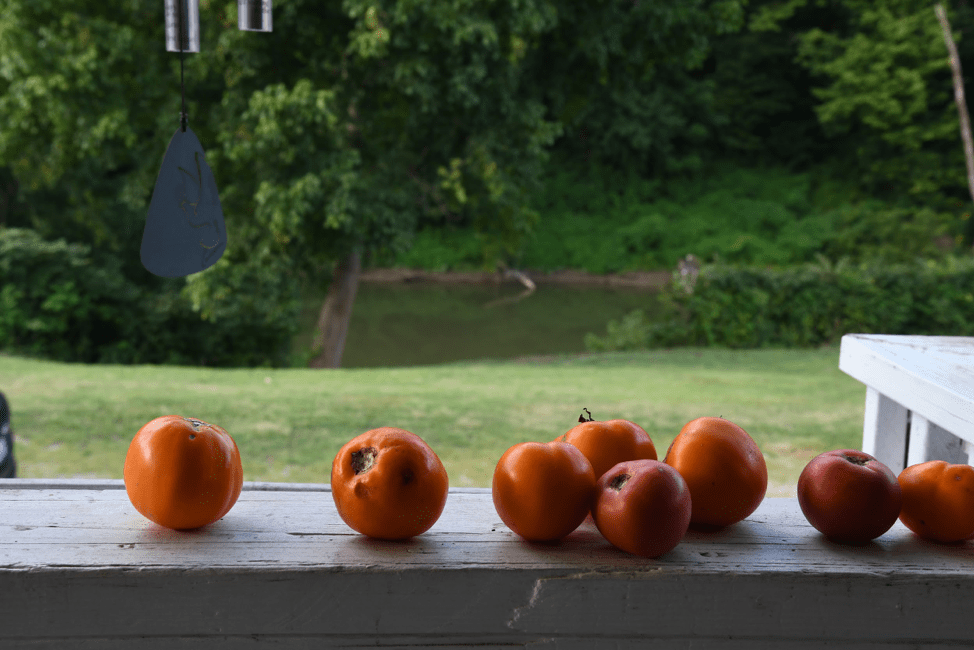
Pictured: A handful of the tomatoes from the garden, with the North Fork of the Kentucky River in the background.
“I planted too many watermelons in one hill. I knew not to plant too many, but I said, well I’m not gonna make a lot of hills, so I’ll just plant a lot of seeds in each hill. When you do that you get more bud than you do watermelon – so all my watermelons are just blooming, that’s all their doing. They’re not producing a whole lot of watermelons.” Garnet jumps in on that.
“You’re ‘sposed to pinch that runner off.”
“I know you are Mom, but you’re not supposed to plant 20 seeds in a hill too.”
It’s those exchanges between Ron and Garnet that bring to light how the Weddingtons have kept a garden big enough to feed themselves, their family, and their neighbors for close to 50 years while Hazard changed around them. Throughout our conversation, Tammy leans over to me, and points to Garnet: “the garden wouldn’t be what it is without her.”
And eating those beans Ron’s still growing from Garnet’s mother is enough to turn you off any other such plant. The Weddingtons don’t want to restrict their garden to family and friends only, either. I’ve asked Ron a few other times to sell the surplus produce they grow at the Perry County Farmers Market. He refuses to sell the food they grow, but would like to teach our neighbors in Walkertown to garden and find ways to distribute surplus for free to the community. In spite of their own family’s energy though, he’s fearful of where gardens will go from here.
“It’s hard to get people interested in gardening. It’s hot – the summer’s are getting hotter, the climate’s changing. But, people are gonna have to get back into gardening if they want healthy food, here in East Kentucky. Because you can’t go to Whole Foods. What you get at Food City, and Save-A-Lots, that’s all we have for grocery stores. There’s just not a whole lot to choose from, and if you want to buy organic, you’re gonna have to pay for it.”
The Weddingtons have all seen and cultivated real excitement in the folks they surround themselves with around home gardening, despite their own concerns. Tammy tells me Ron and her taught her sister to garden. That knowledge passes along too – her sister took the lessons Tammy and Ron gave her to help her father-in-law with his garden.
“He’s on dialysis, but he loved it, and he’s just got a small garden, but she went down and helped him with that, and that helped him. Got him out of the house, feeling better, just by doing that.”
When I leave Walkertown, Ron cuts a bunch of onions they’ve put away in their garage for me, and fills two grocery bags with tomatoes to send along as well. The hopes they hold to start a neighborhood food share day, to give out vegetables and fruits from their garden for free along with other gardeners, and teach their neighbors growing techniques all come from the same spirit that’s never let me leave the porch without at least walking down to pick out cucumbers. Earlier when I asked Tammy how growing food out in Perry County has been different from the garden she’s helping to raise now, she told me this:
“In the city you’re worried about your house looking pretty, your yard being perfect – out in the county, you’ve got a lot more land, your backyard, and so, you’ve got more room to work with, you’re not so much worried about prettiness as you are with food.”
For the Weddingtons though, I think the garden might make the house.
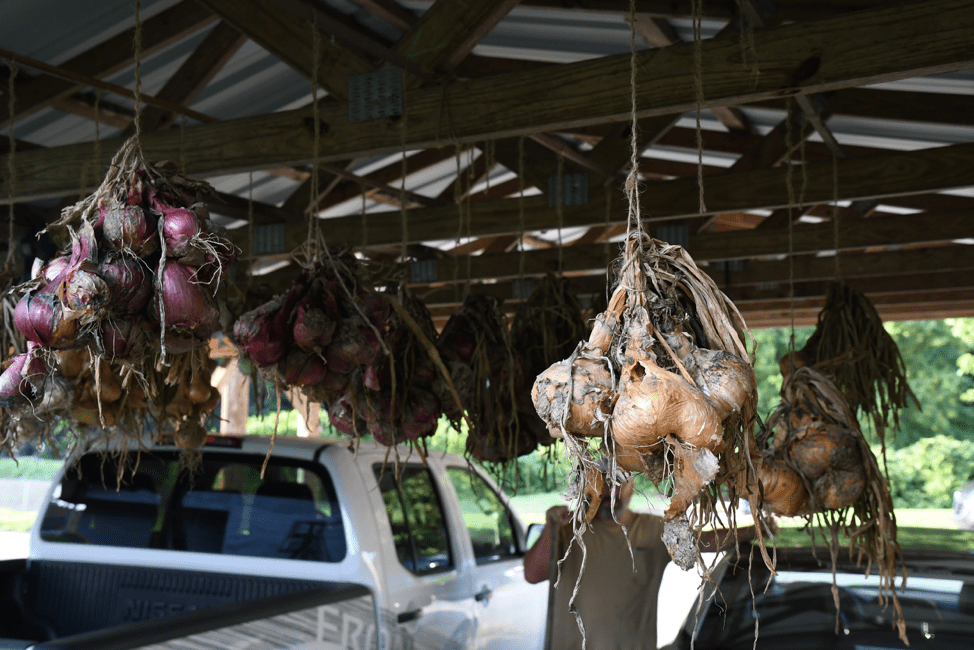
 Pictured: The red, sweet, and yellow onions grown in the Weddingtons’ garden, strung up in their carport.
For support on starting your own garden, please reach out to our friends at Grow Appalachia. They have several sites across the region that support folks in growing their own food, the closest to Perry County being the Hindman Settlement School site, run by Olivia Harp. To learn more about Grow Appalachia please visit their website here.


 Photo: Ford Waterstrat & Family, Sustainable Harvest Farm
 Photo: Ben Abell, RootBound Farm