
Building on the Momentum of HB 278
Kentucky farmers and advocates have made meaningful progress toward expanding poultry processing opportunities in the Commonwealth. While the bill number will change this session, the policy itself is stronger than ever—thanks in large part to the success of HB 278 during the 2025 Kentucky General Assembly.
View the bill here: https://apps.legislature.ky.gov/record/25rs/HB278.html
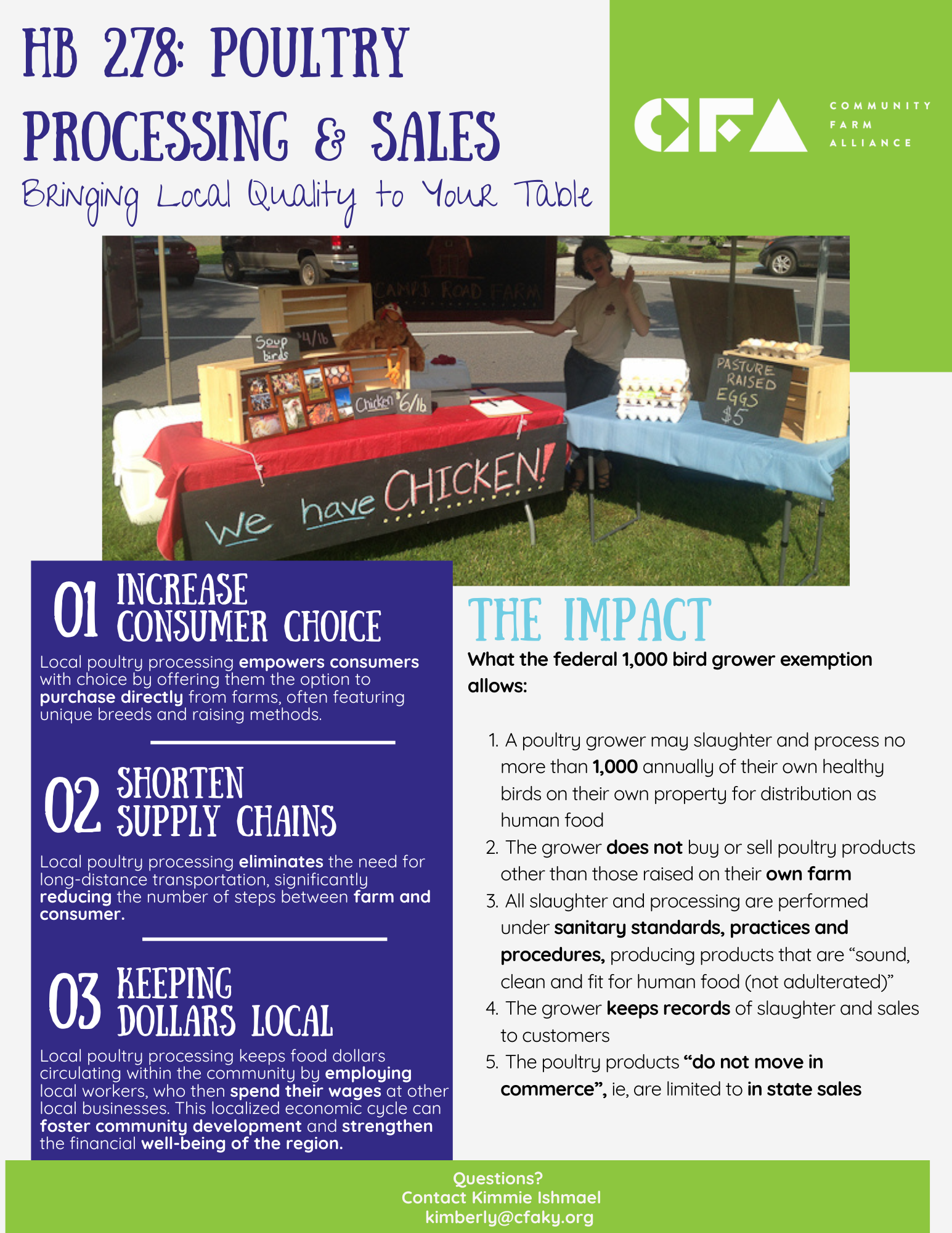
HB 278: A Major Step Forward
During the 2025 legislative session, HB 278 was introduced to address long-standing barriers facing small-scale poultry farmers. The bill proposed aligning Kentucky law with the federal 1,000-bird grower exemption, creating a clear and regulated pathway for limited on-farm poultry processing.
HB 278 passed through the Kentucky House with no opposing votes, a powerful demonstration of bipartisan support for Kentucky farmers, local food systems, and common-sense regulation.
Although the bill did not advance through the Senate due to legislative time constraints, its House passage marked a significant policy win. It confirmed that lawmakers across the political spectrum recognize both the need for reform and the strength of this solution.
The Policy Issue Remains
Federal law has allowed exemptions from continuous poultry inspection for small-scale producers since 1968, following amendments to the Poultry Products Inspection Act of 1957. These exemptions, outlined in 9 CFR 381.10, permit farmers to process a limited number of their own birds on-farm under specific conditions.
Despite this federal framework, Kentucky continues to impose unusually restrictive policies on poultry farmers operating under these exemptions. Kentucky currently has only three USDA poultry processors serving the entire state, creating a significant bottleneck for independent producers trying to access markets.
Limited processing capacity means long wait times, long-distance transport, increased costs, and added stress for both farmers and animals—challenges that existed long before the pandemic and were intensified by it.
What the Grower Exemption Allows
Under the federal 1,000-bird grower exemption:
- Farmers may slaughter and process up to 1,000 healthy birds per year raised on their own farm.
- Poultry products are sold directly to the end consumer only, with no resale.
- All slaughter and processing must follow sanitary standards, practices, and procedures to ensure food safety.
- Farmers must maintain records of slaughter and sales.
- Products are limited to in-state sales and do not enter interstate commerce.
This exemption does not remove oversight. It removes the requirement for continuous on-site inspection while maintaining clear food safety expectations.
Why This Policy Matters
Expanding Farmers Choice
Allowing limited on-farm poultry processing increases the options that smaller farms have to process their birds. This means more time and money saved for our farmers
Expanding Consumer Choice
Allowing limited on-farm poultry processing increases access to locally raised poultry and gives consumers more direct connections to farmers and their food.
Strengthening Local Food Systems
Shorter supply chains reduce transportation distances and increase transparency, resilience, and reliability within Kentucky’s food system.
Keeping Food Dollars in Kentucky
Local processing keeps economic activity in local communities, supporting farm families, rural jobs, and small businesses.
Improving Animal Welfare and Product Quality
Reducing long-distance transport lowers stress on animals and helps preserve the quality of poultry products reaching consumers.
Kentucky’s Opportunity Moving Forward
Kentucky remains one of only two states that has not adopted the grower exemption. The passage of HB 278 in the House made clear that Kentucky is ready to change that.
This session, the policy will move forward again—under a new bill number—building directly on the foundation laid by HB 278. The goal remains the same: give farmers more options, support family farms, and expand access to safe, locally raised poultry.
Looking Ahead
HB 278 showed what is possible. With unanimous House support already behind this policy, Kentucky is closer than ever to meaningful poultry processing reform.
By advancing this policy under a new bill this session, the Commonwealth can:
- Expand poultry processing options for farmers
- Increase consumer choice
- Strengthen local food systems
- Keep food dollars circulating in local economies
Community Farm Alliance is continuing to work alongside farmers and legislators to ensure this policy crosses the finish line.
Questions?
Contact Kimmie Ishmael at kimberly@cfaky.org