Uncategorized

Farm Bill Moves Forward, Budget Signals Cuts: What It Means for Kentucky Agriculture

The U.S. House has passed its version of the Farm, Food, and National Security Act of 2026, marking an important step in a process that has already extended well beyond its original timeline. Attention now shifts to the Senate, where Agriculture Committee leadership, including John Boozman, has indicated that draft legislative text will be released in the coming weeks, though that timeline runs up against a scheduled recess beginning May 22. This creates a narrow and somewhat uncertain window for Senate action, and raises the possibility that negotiations could extend further into the year.

At the same time, the president’s proposed budget introduces a competing set of priorities, including the elimination of several programs that local and regional food systems rely on. Taken together, these developments illustrate both forward movement and continued instability in federal policy affecting Kentucky farmers.  CFA is just about halfway done reading the legislation, but this is a glance at where we are right now.


What the House Farm Bill Does

The House-passed bill largely maintains the existing framework for local and regional food systems, while making targeted adjustments that could have meaningful implications depending on how they are ultimately implemented.

  • Section 2302, State assistance for soil health, expands support and appropriates funding for soil health through state level programming, which has clear relevance for Kentucky given the interest our members have in soil health initiatives across the state. This provision creates additional opportunity to align federal conservation resources with locally driven priorities, though the extent of its impact will depend on final funding levels, state participation, and administrative design.
  • Section 4110, Animal protein an eligible incentive food, makes a notable change within nutrition incentive structures (which appears to affect GusNIP and Farmers Market Nutrition Program, at first glance) by expanding eligibility to include animal proteins. While this adjustment reflects an effort to broaden participation and consumer choice, it also raises important questions about how incentives will be structured in practice and whether support for locally produced fruits and vegetables will remain a central focus within these programs.
  • Section 4306, Local Farmers Feeding Our Communities, is a revamp of the Local Food Purchasing Program and Local Food for Schools Programs, which were very successful in KY. Based on quick calculations, this program may deliver between $2 and $3 million annually to Kentucky farmers, helping to stabilize markets and strengthen local procurement. At the same time, it also allocates funding to administer the program.  Its inclusion in the House bill represents a clear recognition of the role that local purchasing programs play in both farm viability and food access.
  • Section 5109, Heirs Property Resolution through Direct Public Interest Legal Services, addresses heirs property, an issue that continues to affect land access and retention for many producers. By providing funding for attorney and other fees to resolve heirs property issues, this legislation increases pathways for resolving heirs property challenges and has the potential to support long term farmland stability, particularly for multi generational operations.

In addition to these sections, amendments adopted during markup further signal an effort to improve access and usability of federal programs.

  • The Farmer to Farmer Education Act of 2025 provides funding for programs that specifically support peer learning, reinforcing the value of farmer led knowledge exchange. The link above goes to the Senate bill referenced in the amendment.
  • Amendment 45, (scroll down to amendment on this link) The Promoting Access to Local Agriculture, amendment focuses specifically on reducing administrative barriers by making it easier for farmers and farmers markets to register for and participate in federal nutrition incentive programs, a change that could meaningfully expand participation if implemented effectively. 
  • Amendment 54 (scroll down to amendment on this link) requires USDA to provide online enrollment options for disaster assistance programs, addressing a long standing barrier for many smaller operations.

While these policy changes are, on their face, promising, they represent only one stage in a much longer process. The House bill must still be reconciled with a Senate version, assuming the Senate advances its own bill, and ultimately any final provisions will need to be implemented in ways that are accessible, adequately funded, and responsive to on the ground realities.


The Budget Proposal: A Different Direction

In contrast to the House bill, the president’s proposed budget would eliminate funding for several programs that are central to local and regional food systems, particularly those that rely on discretionary funding rather than mandatory baseline support.

Among the programs proposed for elimination are the following:

  • GusNIP Produce Prescription Program, which connects healthcare and food access while creating reliable markets for farmers, including starting CFA’s FreshRx for MOMS, which has resulted in over $500,000 of fresh produce going to mothers on WIC or Medicaid; 
  • the Rural Cooperative Development Grant program, which supports organizations such as the Kentucky Center for Agriculture and Rural Development in providing business development assistance, which builds the backbone to $39 million in economic impact on farms last year;
  • Dairy Business Innovation Centers, which help small and mid sized dairy producers diversify and remain competitive, including at least 2 in KY; 
  • the Acer Access and Development Program, which supports value added forest products, and has helped support KY’s efforts to harvest and market maple; 
  • and the Expanded Food and Nutrition Education Program, which provides nutrition education that often complements local food purchasing efforts through cooperative extension.

Individually, these programs may appear relatively small within the broader federal budget, but collectively they form a critical layer of infrastructure for local food systems. Their elimination would not only reduce direct support to farmers, but also weaken the networks and institutions that make regional markets function.


Where This Leaves Us

At this stage, federal policy is sending mixed signals. The House farm bill maintains and, in some cases, strengthens key local food programs, while the proposed budget suggests a significant pullback in funding for many of those same efforts.

This disconnect underscores a fundamental challenge for local food systems, which are often authorized through legislation but remain dependent on annual appropriations to function. For Kentucky farmers, the outcome will depend not just on what is included in the final farm bill, but on whether those programs are ultimately funded and implemented in a way that allows them to be used effectively.

With the Senate expected to release draft language soon, and appropriations decisions still ahead, the coming weeks will be critical in determining whether recent progress translates into sustained support or continued uncertainty.

This isn’t the last word on Farm Bill and Appropriations

These decisions are not final. Contact your Senators about how the farm bill and budget appropriations about those zeroed out programs if they have supported your farm or community.  Make clear that local food programs must be both protected and funded if they are going to work for farmers and communities.

Uncategorized

Community Farm Alliance 2026 Legislative Session Recap


Table of Contents

  1. Full General Assembly Recap
  2. Newsletter Version
  3. Social Media Version

Full General Assembly Recap

A Session Years in the Making

Sometimes, the biggest wins don’t come with a lot of warning— they come after years of steady, persistent work.

This legislative session, we saw exactly that.

For years, farmers across Kentucky have been speaking up, organizing, and pushing for practical solutions to real barriers. This year, those voices broke through. Because of you— our members, farmers, and advocates— we made meaningful progress toward a more fair and functional food and farm system.

This wasn’t luck. It was a movement.

By the Numbers

  • Bills tracked: 30+
  • Priority issues advanced: 3
  • Bills passed into law: 2
  • Farmers engaged: 5+
  • Years of advocacy behind our biggest win: 5+

Top Wins

#1 Senate Bill 73: A Strategic Path Forward for On-Farm Poultry Processing

Sometimes, the work of advocacy is long and steady and then, the path forward takes a turn you don’t expect.

For years, Community Farm Alliance and Kentucky farmers have been working to remove barriers to limited on-farm poultry processing. This session, that effort was introduced as its own standalone piece of legislation. Like many good bills, it faced the realities of a crowded legislative calendar and a competitive policy environment.

But the story didn’t end there.

As the session moved forward, an opportunity emerged. The on-farm poultry processing legislation was taken from its original bill and added as an amendment to Senate Bill 73—a broader bill that was already moving through the legislature with momentum.

That strategic shift made all the difference.

Why this matters:

  • Opens new market opportunities for small-scale farmers
  • Reduces bottlenecks in processing access
  • Strengthens local food systems across Kentucky

How it happened:
This win reflects both years of groundwork and the ability to adapt in real time. Farmers and advocates laid the foundation by consistently elevating this issue. So when the legislative opening appeared, the policy was ready. By attaching it to Senate Bill 73, supporters were able to carry the provision across the finish line in a way that standalone legislation often cannot.

What it means moving forward:
With Senate Bill 73 set to take effect within 90 days, Kentucky farmers will soon have expanded access to limited on-farm poultry processing—removing a key bottleneck and opening new pathways for local production and sales.

#2 Senate Bill 5: Expanding Markets for Kentucky Farmers

This session also brought an important win for farmers selling into local school systems.

Senate Bill 5 creates new flexibility for Kentucky school districts to purchase Kentucky-grown agricultural products by removing certain state-level bidding barriers, while still following federal guidelines.

Why this matters:

  • Makes it easier for schools to buy directly from Kentucky farmers
  • Expands reliable, institutional markets for local producers
  • Strengthens farm-to-school connections across the state

What it changes:
School districts participating in USDA Child Nutrition Programs can now:

  • Use more flexible purchasing methods for Kentucky-grown products
  • Bypass certain state procurement restrictions that previously limited local purchasing
  • Increase opportunities for smaller-scale farmers to compete in these markets

This is a meaningful step toward keeping more food dollars in Kentucky communities—and getting fresh, local food onto school trays.

#3 Senate Joint Resolution 23: Advancing Food as Medicine Through Kentucky Agriculture

Not all wins come in the form of immediate policy change. Some set the stage for what’s next. This session, Kentucky took an important step toward recognizing something farmers have always known: food is not just fuel—it’s medicine.

Senate Joint Resolution 23 moves forward a deeper exploration of “Food is Medicine” approaches, creating space for collaboration between agriculture, healthcare, and state agencies. At its core, this effort looks at how fresh, nutritious food can play a role in improving health outcomes across the Commonwealth.

Why this matters:

  • Positions local, Kentucky-grown food as a key part of improving public health
  • Creates new opportunities for farmers to be part of healthcare solutions
  • Strengthens connections between local agriculture and community well-being

What it does:

  • Encourages study and coordination around Food is Medicine initiatives
  • Brings together stakeholders from agriculture, healthcare, and government
  • Explores how programs can source food directly from Kentucky farmers

How it fits into the bigger picture:
For Community Farm Alliance members, this is about more than policy—it’s about recognizing farmers as part of the solution to some of our biggest challenges. When local farms are the source of the “medicine,” we’re not only improving health outcomes, we’re investing in Kentucky’s rural economies, supporting small-scale producers, and building a food system that truly cares for people and place.

Progress Was Made

Soil Conservation, Heirs Property Rights, & More

We saw important movement this session, even if the finish line is still ahead.

  • Built stronger awareness among legislators
  • Gained new champions in the General Assembly
  • Advanced conversations that will shape future policy

This is how change happens—step by step, session by session.

Challenges & What We Learned

Like any legislative session, not everything went our way. Some priorities didn’t move as far as we hoped, and in some cases, we faced familiar challenges—limited time, other issues being prioritized because of the budget, and the need to educate more legislators and decision makers. But every conversation, every testimony, and every connection built lays the groundwork for what comes next.

We’re leaving this session stronger, more connected, and better positioned for the future.

What This Means Moving Forward & Looking Ahead

With new policies on the books, the work now turns to implementation—but it doesn’t stop there.

We’ll be tracking how these changes roll out, supporting farmers as they navigate new opportunities, and making sure the intent of the law translates into real impact on the ground.

At the same time, we’re carrying this momentum forward. The work continues as we look ahead to 2027 and beyond:

  • Strengthening local and regional food systems through programs like KY Double Dollars, Farm to School, and Food is Medicine
  • Supporting the next generation of farmers through farmland transition policies
  • Prioritizing healthy soils to build stronger farms, healthier watersheds, and more resilient agricultural communities

And through it all, we’ll keep building the relationships and grassroots power it takes to get there.

Because of You: We Are Stronger Together

This progress didn’t happen in Frankfort alone— it was built in communities across Kentucky, powered by people like you.

Farmers and members showed up! From meeting with decision-makers to sending emails and making calls to sharing their stories. And those very stories helped shaped policy.

For years, farmers pushed for change to make poultry processing work for small-scale operations. This session’s win is a direct result of that persistence.

Now that on-farm processing is finally allowed, we want to hear what this means for you.

Share your story:
https://forms.monday.com/forms/f0a8cba88a7db4be1d8eace148191b37?r=use1

We’ll be lifting up farmer voices across the state to show the real impact on farms, incomes, and communities— because this is what grassroots advocacy looks like in action.

Stay Involved

This movement is only as strong as the people behind it.

Because lasting change doesn’t happen in a single session—it happens when people stay in it for the long haul.

With Gratitude

To every farmer, member, and supporter who showed up, spoke out, and stayed committed— thank you.

This progress belongs to you. And we’re just getting started.

Newsletter Version

A Session Years in the Making

Sometimes the biggest wins come after years of steady, persistent work—and this legislative session proved it.

Because of farmers, members, and advocates across Kentucky, we made meaningful progress toward a stronger, more fair food system. This wasn’t luck. It was years of organizing, storytelling, and showing up when it mattered.

By the Numbers

  • 30+ bills tracked
  • 3 priority issues advanced
  • 2 bills passed into law
  • 5+ years of advocacy behind our biggest win

Top Wins

Senate Bill 73 – On-Farm Poultry Processing
After years of advocacy, language allowing limited on-farm poultry processing crossed the finish line by being added as an amendment to SB 73.
Impact: Expands market access, reduces processing bottlenecks, and strengthens local food systems.

Senate Bill 5 – Farm to School Expansion
Creates more flexibility for schools to purchase Kentucky-grown food.
Impact: Opens reliable markets for farmers and keeps more food dollars local.

Senate Joint Resolution 23 – Food is Medicine
Launches exploration into how Kentucky-grown food can support better health outcomes.
Impact: Positions farmers as key partners in public health solutions.

We also built momentum on soil conservation, heirs property, and more— laying the groundwork for future wins.

None of this happened by chance. Farmers, members, and partners showed up, spoke out, and worked together to move change forward.

So what’s next? Implementation— and continued advocacy to build a stronger, more resilient food and farm system.

This is grassroots advocacy in action. And it works.

Social Media Version

Big wins. Years in the making.

This legislative session, Kentucky farmers turned persistence into progress.

After years of advocacy, we helped:
✔ Expand on-farm poultry processing
✔ Grow farm-to-school opportunities
✔ Move “Food is Medicine” forward

This didn’t happen overnight. It took 5+ years of advocacy, organizing, and showing up. This progress was powered by farmers, members, and partners showing up and speaking out.

Because of you, we’re building a stronger, more local food system. This is what grassroots advocacy looks like— and it works.

We’re just getting started.


Uncategorized

Policy Update – March 31, 202


As the 2026 session of the Kentucky General Assembly moves toward its final stretch, several key policy decisions are taking shape that will impact the future of farming, local food systems, and nutrition access across the Commonwealth. At CFA, we’re continuing to advocate for policies that support Kentucky farmers, strengthen local markets, and connect more Kentuckians to fresh, locally produced food.

This year, three core issues have guided our work for our members: protecting farmland ownership, investing in soil health, and expanding market opportunities for small and mid-scale farmers. The following bills represent important steps toward addressing these challenges and strengthening the long-term viability of Kentucky family farms:

  • Senate Bill 73: Originally introduced as separate poultry legislation and now incorporated into broader policy discussions, SB 73 would allow certain USDA-exempt poultry producers to process up to 1,000 birds on-farm and sell directly to consumers at farms, farmers markets, and roadside stands. This change would expand market access for small-scale producers and help meet growing demand for locally raised meat. The bill has been delivered to the Governor.
    👉 https://apps.legislature.ky.gov/record/26rs/sb73.html
  • Senate Bill 5 (SIGNED INTO LAW): This legislation makes it easier for schools to purchase Kentucky-grown agricultural products by reducing state levle procurement barriers, which starts to address strengthening farm-to-school connections and expanding markets for local producers.
    👉 https://apps.legislature.ky.gov/record/26rs/sb5.html
  • House Bill 197: This legislation would create a Healthy Soils Program and Fund to support farmers and landowners implementing soil-building practices through grants, technical assistance, and planning support.
  • Senate Bill 23: This bill would establish a clearer legal process when farmland is inherited by multiple family members without a will—helping families hold onto their land and reducing the risk of forced sales that can lead to land loss.
  • House Bill 871: This piece of legislation would establish a Kentucky Farm to School Program and dedicated fund. The program would reimburse school districts for meals that include Kentucky-grown products and require participating districts to develop plans to increase local purchasing and food education opportunities. 

Together, these conversations reflect a growing recognition that strong farms and healthy communities go hand in hand. From protecting family farmland to expanding local food markets, improving soil health, and supporting small-scale processing, the decisions made during this legislative session will have lasting impacts on Kentucky agriculture.

We’ll continue working alongside our members, farmers, community partners, and policymakers to advance solutions that strengthen family farms and build a more resilient local food system for Kentucky.

Uncategorized

Protecting Family Land in Kentucky: Why the Uniform Partition of Heirs’ Property Act Matters

For generations, family land has been a cornerstone of farming, community, and cultural identity in Kentucky. Yet for many families—especially those who inherit land without a will—this legacy is at constant risk. The Uniform Partition of Heirs’ Property Act (UPHPA) offers a proven solution to protect heirs’ property, keep land in families, and support generational farming. Kentucky has debated this policy for years, and the need has never been more urgent.

The Issue: What Is Heirs’ Property?

Heirs’ property is created when land passes without a will to two or more descendants, who then own the property together as “tenants in common.” Over time, ownership can become fractured among many heirs, often without clear title or documentation.

This tangled ownership structure makes families especially vulnerable. Land speculators can purchase a small share of the property and then force a partition sale—often at a price far below fair market value. Families lose land not because they want to sell, but because the law allows it.

Research across the Cotton Belt of the U.S. South has shown that heirs’ property is closely linked to land loss and low wealth, particularly in African American communities. The USDA has identified heirs’ property as the leading cause of African American involuntary land loss. The issue is also common in regions facing entrenched poverty, including Central Appalachia.

Heirs’ property has been called “the worst problem you never heard of,” yet its impacts are deeply felt by Kentucky farmers and landowners.

Why It Matters for Farmers and Rural Communities

Without clear title, heirs often face serious barriers:

  • Inability to access loans or mortgages
  • Ineligibility for USDA grants and programs
  • Limited ability to build wealth through farming, timber sales, or other land-based enterprises

At the same time, unclear ownership leaves land vulnerable to acquisition by real estate developers and unscrupulous actors. The result is land loss, weakened rural economies, and the erosion of generational farming traditions.

The Solution: The Uniform Partition of Heirs’ Property Act

The Uniform Partition of Heirs’ Property Act (UPHPA) is designed to address these challenges while respecting the rights of all property owners.

UPHPA applies only to heirs’ property—when one or more co-tenants inherited their interest from a relative and there is no written agreement governing partition. The act preserves a co-tenant’s right to sell their share while adding critical protections for families who want to keep their land.

Under UPHPA, courts must:

  • Provide notice and independent appraisal of the property
  • Give co-tenants the right of first refusal to purchase a selling owner’s share
  • Order a partition-in-kind (physical division of land) whenever feasible
  • Require any forced sale to be commercially reasonable and at fair market value

In short, UPHPA ensures due process and fairness, preventing forced sales that strip families of land and wealth.

Where Kentucky Stands

Last year, this policy was introduced in Kentucky as Senate Bill 70, but it did not pass. In the current legislative session, the bill has been filed again as Senate Bill 23. As of now, SB 23 has not yet been assigned to a committee.

This legislation has been introduced in Kentucky for many years in a row and has never passed—despite broad evidence of its effectiveness and the clear need among Kentucky farmers and landowners.Meanwhile, the Uniform Partition of Heirs’ Property Act has been enacted in 17 states across the country. Neighboring and peer states have recognized that protecting heirs’ property is essential to preserving family land, strengthening rural economies, and addressing historic and ongoing inequities in land ownership.

Why This Matters Now

Every year Kentucky fails to pass UPHPA, more families lose land they intended to keep. More farmers are locked out of critical programs and opportunities. More communities lose the chance to build long-term, land-based wealth.

Passing SB 23 would be a meaningful step toward:

  • Keeping land in Kentucky families
  • Supporting generational farming
  • Protecting vulnerable landowners from forced sales
  • Strengthening rural and Appalachian communities

This is not a new idea—it is a proven solution. And for Kentucky’s farmers and landowners, it is long overdue.

Uncategorized

Advancing Poultry Processing in Kentucky

Building on the Momentum of HB 278

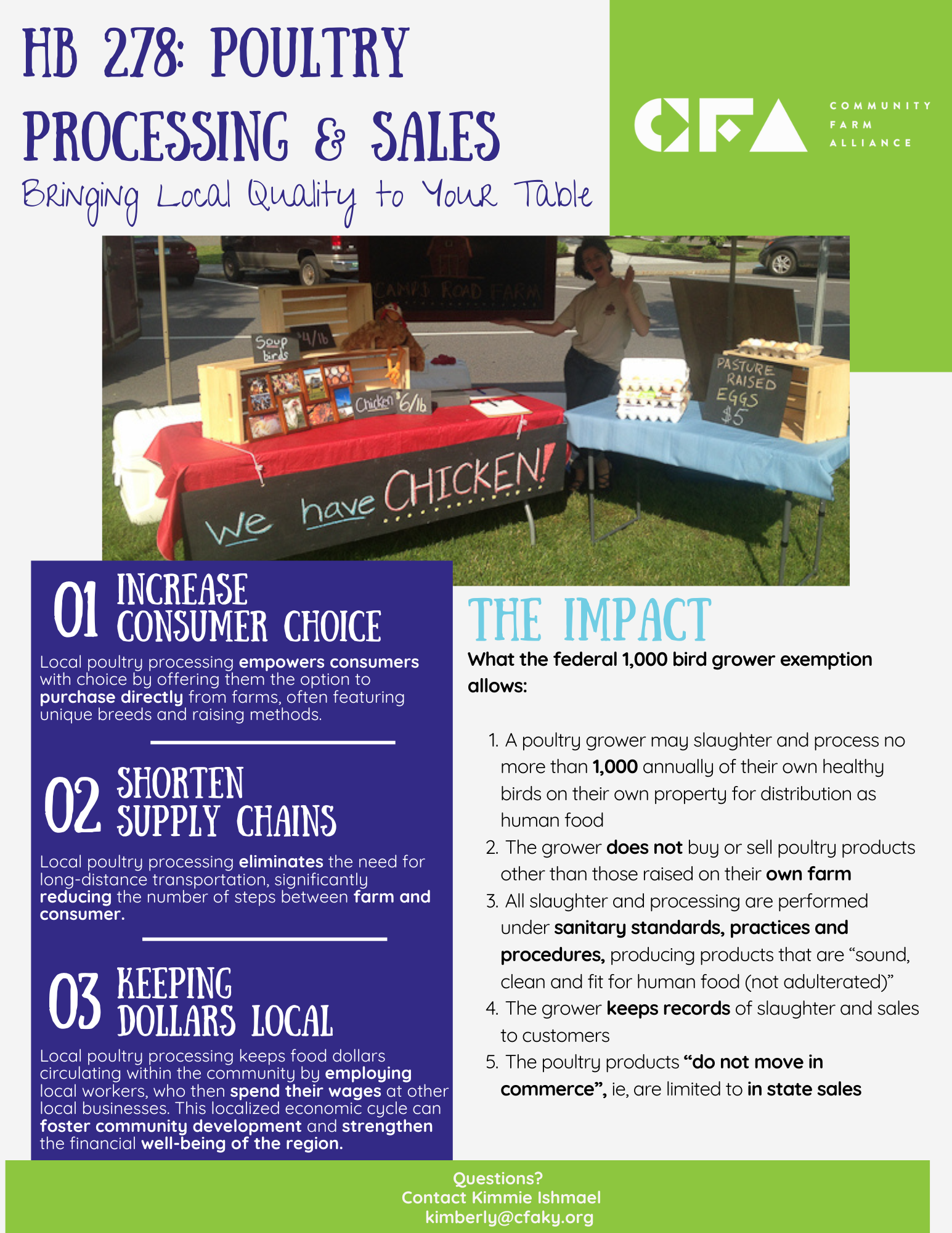
Kentucky farmers and advocates have made meaningful progress toward expanding poultry processing opportunities in the Commonwealth. While the bill number will change this session, the policy itself is stronger than ever—thanks in large part to the success of HB 278 during the 2025 Kentucky General Assembly.

View the bill here: https://apps.legislature.ky.gov/record/25rs/HB278.html

HB 278: A Major Step Forward

During the 2025 legislative session, HB 278 was introduced to address long-standing barriers facing small-scale poultry farmers. The bill proposed aligning Kentucky law with the federal 1,000-bird grower exemption, creating a clear and regulated pathway for limited on-farm poultry processing.

HB 278 passed through the Kentucky House with no opposing votes, a powerful demonstration of bipartisan support for Kentucky farmers, local food systems, and common-sense regulation.

Although the bill did not advance through the Senate due to legislative time constraints, its House passage marked a significant policy win. It confirmed that lawmakers across the political spectrum recognize both the need for reform and the strength of this solution.

The Policy Issue Remains

Federal law has allowed exemptions from continuous poultry inspection for small-scale producers since 1968, following amendments to the Poultry Products Inspection Act of 1957. These exemptions, outlined in 9 CFR 381.10, permit farmers to process a limited number of their own birds on-farm under specific conditions.

Despite this federal framework, Kentucky continues to impose unusually restrictive policies on poultry farmers operating under these exemptions. Kentucky currently has only three USDA poultry processors serving the entire state, creating a significant bottleneck for independent producers trying to access markets.

Limited processing capacity means long wait times, long-distance transport, increased costs, and added stress for both farmers and animals—challenges that existed long before the pandemic and were intensified by it.

What the Grower Exemption Allows

Under the federal 1,000-bird grower exemption:

  • Farmers may slaughter and process up to 1,000 healthy birds per year raised on their own farm.
  • Poultry products are sold directly to the end consumer only, with no resale.
  • All slaughter and processing must follow sanitary standards, practices, and procedures to ensure food safety.
  • Farmers must maintain records of slaughter and sales.
  • Products are limited to in-state sales and do not enter interstate commerce.

This exemption does not remove oversight. It removes the requirement for continuous on-site inspection while maintaining clear food safety expectations.

Why This Policy Matters

Expanding Farmers Choice
Allowing limited on-farm poultry processing increases the options that smaller farms have to process their birds. This means more time and money saved for our farmers

Expanding Consumer Choice
Allowing limited on-farm poultry processing increases access to locally raised poultry and gives consumers more direct connections to farmers and their food.

Strengthening Local Food Systems
Shorter supply chains reduce transportation distances and increase transparency, resilience, and reliability within Kentucky’s food system.

Keeping Food Dollars in Kentucky
Local processing keeps economic activity in local communities, supporting farm families, rural jobs, and small businesses.

Improving Animal Welfare and Product Quality
Reducing long-distance transport lowers stress on animals and helps preserve the quality of poultry products reaching consumers.

Kentucky’s Opportunity Moving Forward

Kentucky remains one of only two states that has not adopted the grower exemption. The passage of HB 278 in the House made clear that Kentucky is ready to change that.

This session, the policy will move forward again—under a new bill number—building directly on the foundation laid by HB 278. The goal remains the same: give farmers more options, support family farms, and expand access to safe, locally raised poultry.

Looking Ahead

HB 278 showed what is possible. With unanimous House support already behind this policy, Kentucky is closer than ever to meaningful poultry processing reform.

By advancing this policy under a new bill this session, the Commonwealth can:

  • Expand poultry processing options for farmers
  • Increase consumer choice
  • Strengthen local food systems
  • Keep food dollars circulating in local economies

Community Farm Alliance is continuing to work alongside farmers and legislators to ensure this policy crosses the finish line.

Questions?
Contact Kimmie Ishmael at kimberly@cfaky.org