Fiber Podcast, Woven Roots

Woven Roots Podcast #7 Fiber Tells a Story: Flax, Hide Tanning, and the Magic of Fiber Arts at Cedar Creek Farm

Aired: December 12, 2017

In this special final episode of Woven Roots, Appalachian Transition Fellow, Sam Hamlin, joins Candace Mullins and Micah Wiles for their first Fiber Day on Cedar Creek Farm in Somerset Kentucky.

Nestled in the hills of Pulaski County, Cedar Creek Farm is operated by Micah Wiles and his family. It is home to a multitude of agricultural endeavors, including: raising heritage breed Dexter cattle for grass-fed beef, operating a vineyard and winery, and caring for vegetable gardens and fruit and nut trees, and tanning a variety of hides using sustainable practices. In addition, Candace Mullins grows a small plot of flax on the farm each year and is experimenting with small-scale linen production. For more information on the Wiles family’s diversified farm, see Sister Kathy Curtis’ Breaking Bean Piece, Cedar Creek Farm: A Model for Sustainability.

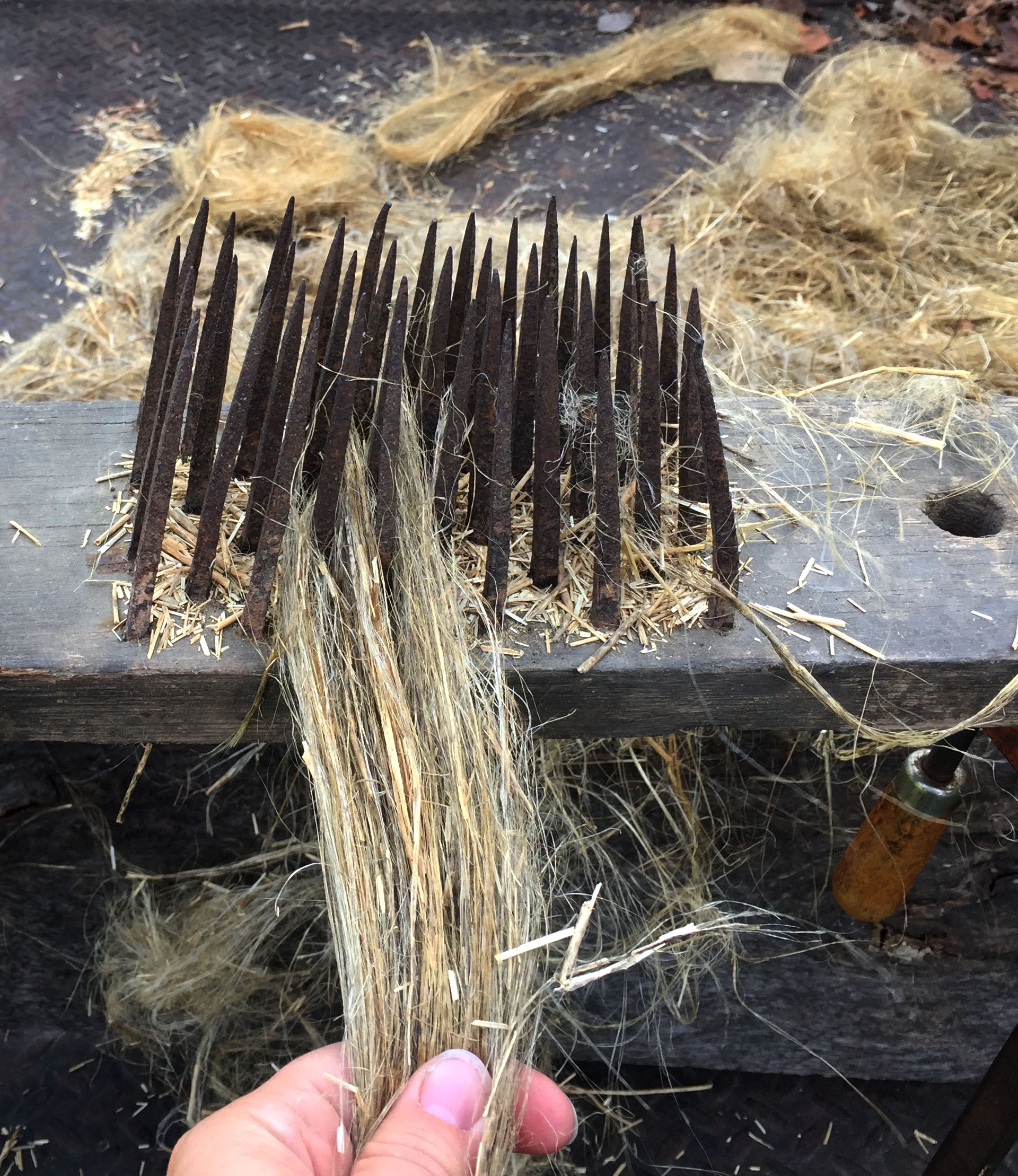
In late October, Candace and Micah hosted their first Fiber Day at the farm, with the goal of bringing together farmers, artisans, and all those interested in working with natural fiber to build relationships and to learn from one another. After eating a delicious, home-made lunch, participants took the opportunity to explore different modes of fiber production including natural dyeing, spinning, and hide tanning. Participants also had the opportunity to hand-process flax fiber, using a break and hackles, a method of processing bast fibers that has been used for centuries.

To begin this episode of Woven Roots, Sam Hamlin talks with Candace Mullins to learn more about her work growing, processing, and spinning flax for linen. Candace shares about her experience discovering the power of weaving and Appalachian fiber arts at Berea College, her vision for collaborative fiber production in Kentucky, and finally, on the power of fiber to tell stories.

Next, Sam Hamlin talks with Micah Wiles about hide tanning on the farm. Micah is committed to ethical and sustainable tanning practices. Unlike many contemporary large-scale tanneries that use toxic heavy metals, Micah uses natural tanning methods that are friendly to the environment to create quality, durable hides. In addition, he sources from local materials. He shares about the tanning process, as well as his visions for creating high quality, natural fiber products.


To close the episode, Sam sits down with Phillip Willet, master spinner and weaver in Berea, Kentucky. In addition to creating beautiful yarns, hand-dyed with natural dyes such as indigo and marigold, Phil is looked up to by many aspiring weavers as a teacher and mentor. Phil talks about his journey into the world of fiber arts and about the pleasure of working with natural fibers.


For information on Cedar Creek Farm, including their tannery, visit their website at: http://www.cedarcreekfarmky.com/

Check out Sam Hamlin’s Woven in Kentucky: An Assessment of the Natural Fiber Textile Sector in Appalachian Kentucky to learn more about Community Farm Alliance’s work with natural fiber.


Fiber Podcast, Woven Roots

Woven Roots Episode #6: Made in Kentucky: Carlisle’s Textile Journey

Aired: November 30, 2017

Nestled in the rolling hills of Kentucky’s Bluegrass region, the town of Carlisle is home to around 7,000 people. Carlisle used to be home of two manufacturing plants for Jockey International, a textile manufacturer and distributor of underwear and sleepwear for men, women, and children. In 2000, Jockey closed up its sewing plant in Carlisle, laying off 326 people. Four years later Jockey moved its operations to Mexico and closed its Carlisle knitting plant, as well as the nearby Maysville and Mount Sterling facilities, affecting 440 total jobs in the region. Jockey’s closing had devastating impacts on the once bustling town of Carlisle, as young people began to leave in search for work elsewhere and high-wage jobs nearly disappeared. However, the economy of Carlisle is currently growing with a movement towards regional economic development and textile revitalization.

In early autumn, Appalachian Transition Fellow, Sam Hamlin sat down with Tracy-Pratt Savage, Development Director in Carlisle-Nicholas County, and also member of Carlisle-Nicholas County’s Chamber of Commerce, to talk about what folks are doing to revitalize textiles in the area through innovative production that taps into high-end and niche markets. For example, high-end baby bedding company, Liz and Roo, moved its operations to Carlisle in 2016. Custom sewing for Liz and Roo is done at the former Jockey International plant, now owned by Carlisle-owned and operated, 3 Star Industries, which sews premium covers for utility vehicles and manufactures windshields.

One of the challenges that many emerging rural textile companies face is a shortage of skilled workers to take newly-created positions. Tracy talks about how folks in Carlisle are attempting to address this problem though an exciting partnership with the Maysville Technical and Community College to develop a textile and sewing certificate program to assist young people in developing the skills needed to work in textile manufacturing.

The episode concludes with a discussion about an approach to economic development that Tracy calls rural regionalism. Rather than going it alone in efforts to revitalize their economy, folks in Nicholas County are working with other small towns in surrounding counties to build up region-wide textile manufacturing, tourism, and community collaboration.

For more information on Carlisle’s history and current endeavors, visit the Nicholas County Economic Development Authority at nicholascounty.ky.gov.

This December, keep a look out for our special final episode on hide tanning, flax, and weaving arts at Cedar Creek Farm.


Woven Roots

Woven Roots Fiber Podcast #5: Industrial Hemp

Aired: November 22, 2017

by Appalachian Transition Fellow, Sam Hamlin

Over the last few years there has been a huge buzz about the potential for the revival of industrial hemp, which is one of Kentucky’s oldest crops. According to the Kentucky Department of Agriculture, industrial hemp is a variety of Cannabis sativa and is of the same plant species as marijuana. However, hemp is genetically different from marijuana and distinguished by its use and chemical makeup. Industrial hemp refers to cannabis varieties that are primarily grown as an agricultural crop for fiber, food, seed, and medicine. Hemp plants are low in THC, which is marijuana’s primary psychoactive chemical.

Hemp growth in Kentucky dates back to the late 1700s. According to the Kentucky Department of Agriculture, Kentucky was the leading hemp-producing state in the mid-19 century, producing up to 40,000 tons in 1850. Hemp, along with flax and wool, were all used as the primary sources for textile production. With the criminalization of marijuana in the 1930s; hemp production was also made illegal. It was not until the 2014 farm bill that hemp could be legally produced with a license under a research pilot program in Kentucky. However, farmers and processors face unique hurdles in hemp production due to the strict regulations of the crop. Industrial hemp plants, including stalks, flowers, and seeds remain a controlled substance under state and federal law. This means that no person can grow, handle, or process industrial hemp in the state without a license from the Kentucky Department of Agriculture. For more on laws and regulations around industrial hemp growth, see the Kentucky Department of Agriculture’s website.

Despite the regulations, the 2014 farm bill paved the way for farmers to produce hemp for fiber and textiles, medication in the form of Cannabidoil (CBD), grain, and food products such as hemp hearts, and much more.

In this episode of the Woven Roots Fiber Podcast, we hear about two innovative Kentucky hemp projects. First, App Fellow Sam Hamlin interviews Preston Jones, Assistant Director of Pine Mountain Settlement School in Harlan County. Preston shares about the first year of hemp production at the Settlement School and on how hemp can help farmers of Eastern Kentucky diversify their production to create high-quality value-added products for niche markets.

Next Sam Hamlin travels to Lexington to talk with Kristofer Nonn, Director of Design and Construction at the North Limestone Community Development Corporation.

The North Limestone CDC initiated a project to build Kentucky’s first-ever hemp house, with walls made of Kentucky-grown hempcrete. Kristofer shares information about how the project came about, what hemp has to do with affordable housing construction, and his dreams and possibilities for the Kentucky hemp sector, overall.

Fiber Podcast, Woven Roots

Woven Roots Fiber Podcast #4: Farm to Fashion: Lan Mark Farm and Feltloom

Aired: November 8, 2017

In this episode, Appalachian Transition Fellow Sam Hamlin travels to central Kentucky to hear from farmer, mill owner, and fiber innovator, Lanette Freitag of Lan Mark Farm and Feltloom. We’ll hear about how one Kentucky farming family created a needle felting machine that has made a big impact on small-scale fiber production around the globe.

Photo credit to Ruth Ann Smith.

In the Central Kentucky, just outside of Sharpsburg, Lanette Freitag and Don Bowles ­operate Lan Mark farm, where they raise sheep, llamas, and alpaca. They also operate a small wool mill where they process and dye their own fibers from their farm. Lan Mark Farm is home to the Feltloom, which is a needle felting machine capable of processing natural fibers into felt cloth. What began as a creation that Lanette and Don developed to more efficiently process their own fiber, has grown into a global processing tool for small-scale fiber farmers, processors, and designers across the world. Feltloom is now sold in 17 countries around the globe.


Listen to this interview with Lanette Freitag to hear about her work on Lan Mark Farm, Feltloom, and the Feltloom’s annual Farm to Fashion show held right here in Kentucky. To learn more about Lan Mark Farm and the Feltloom, and to view their product line, visit their website at http://www.feltloom.com/

Woven Roots: The Appalachian Fiber Story Project is an initiative of the Community Farm Alliance to tell the story of how fiber farming, arts, and entrepreneurship in Appalachian Kentucky can contribute to a bright future in the mountains.


Woven Roots

Woven Roots Fiber Story: A Dream of Indigo: Growing Natural Plant Dyes in South Central Kentucky

by Sam Hamlin, Appalachian Transition Fellow

Aired: October 25, 2017

In late August, CFA Appalachian Transition Fellow, Sam Hamlin, travelled to the Edmonton, Kentucky to visit Hill and Hollow Farm, where one family is growing natural dyes and a whole lot more. Nestled in the rolling hills of south central Kentucky, Hill and Hollow Farm is home to dozens of sheep, acres of organically-grown vegetables, a small plot of Japanese indigo and the farm’s dedicated owners, Robin Verson, her husband Paul Bela, and their lovely children.

When we pulled up to the farmhouse, Robin, who is wearing a beautifully-colored, naturally-dyed deep blue indigo shirt, warmly welcomes us with a big smile and stories of her most recent natural dyeing workshop on harvesting indigo leaves to make a natural textile dye.

Years before moving to Kentucky, Robin and Paul dreamed of owning and operating their own organic vegetable farm. Robin fell in love with farming in her twenties by accident. She came to agriculture by-way of her passion for local, organic food and healthy food access. She started volunteering on a farm outside of Chicago as part of a work-share program in a local Community Supported Agriculture (CSA). During her first weekend on the farm, she met her two great loves: organic farming and her husband Paul, who was also volunteering on the farm. In the late 1990s, she and Paul went on the search for affordable land. They settled on a 60-acre plot in Edmonton, Kentucky, just two hours northeast of Nashville and one hour west of Somerset.

Robin and Paul now operate Hill and Hollow Farm, which has found its primary success as a certified organic vegetable farm, operated through a CSA model. Each season, about fifty families sign up for CSA shares, which Robin delivers weekly to the farmers’ market in Nashville.

In addition to growing organic vegetables, Paul and Robin have a flock of several dozen Jacob and Dorset sheep. Robin jokes that though the sheep won’t listen to her, Paul is the true shepherd of the family; the sheep dutifully follow his every command. Robin and Paul sheer their own sheep and get their wool processed through a few different mills in the region. They sell yarn, roving, sheepskins, and a select number of hand-woven and knitted items through their Etsy page and at the Nashville Farmers’ Market.

Once again by accident, Robin discovered her love for fiber and natural dyes. In 2006, Paul was offered sheep as a payment for a fencing repair job. Paul and Robin have a good amount of pasture on their land, so it made sense to invest in livestock. After they obtained other sheep by chance from a friend, word got out that they accepted sheep and their flock grew substantially, as did Robin’s love for natural dyes. Robin laughed as she told us the story: “Once people realized that we’d accept sheep, it seemed like it went on and on from there. So that’s how the fiber started. And once you have wool, you want to turn it colors, inevitably.”

In 2007, friends of Robin’s from Nashville came up to Edmonton to do a natural dye workshop at the farm. At the time, Robin was not growing any plants to use for dyes, though, they did use walnuts harvested from the farm to create brown hues. Robin explained how fun and exciting the workshop was and that next year she decided to see what plants she could grow for color. She tried working with Hopi sunflowers, marigolds, and Japanese indigo. The deep blue color created by the indigo blew Robin away, so she decided to focus on raising and perfecting her Japanese indigo crop.

Indigo has been harvested as used as a source for natural dye across the globe for thousands of years. The earliest known Peruvian indigo-dyed fabric dates back to over 6,000 years ago.[1] Often harvested by hand, artisans can make vats of indigo dye by combining fresh indigo leaves with water. Indigo is known to be one of the most practical and environmentally-friendly dyes, given that unlike most others, it does not require a mordant. A mordant is an a chemical added to a dye mixture to ensure that natural fibers will hold the color in a lasting way. Indigo makes dyeing without a mordant possible, which not only means that less chemicals are used in the process of dyeing, but also that artisans require less equipment to create vibrant colors.[2]

Robin harvests all of her indigo by hand during the peak harvesting season in August. Just up the road from her farm she runs a natural dyeing studio, where she dyes her own yarns and holds natural dyeing workshops. To make indigo dye, she mixes fresh indigo leaves with cold water to make a vat. She directly dips cloth and yarn into the vat; cloth and yarn made from animal fibers, such as wool and alpaca, take up color best. The longer the cloth or yarn stays in the vat, the deeper blue is the color. In addition to indigo, Robin also uses wild-harvested goldenrod, which grows abundantly right next to her dye studio, to create a vibrant yellow dye. While she creates vibrant yellow goldenrod yarns and deep blue indigo yarns individually, she also creates a green yarn through a process called overdyeing. Yarn that is overdyed is first dipped in an indigo vat and then dipped again in a goldernrod vat, creating a beautiful mossy green color.

Robin sells skeins of naturally dyed yarn processed from her own sheep, as well as yarn made from a sheep and alpaca blend. On Hill and Hollow Farm’s Etsy page, fiber enthusiasts can find Jacob’s sheep roving and yarn, Dorset sheep yarn that is naturally dyed with indigo and native goldenrod, lamb skins (available seasonally), and hand-knitted and woven items created from fiber that came straight from Robin and Paul’s farm. For more information about Hill and Hollow Farms, visit their website at www.hillandhollowfarm.com, and find them on facebook and Etsy.

[1] 6,000-year-old fabric reveals Peruvians were dyeing textiles with indigo long before Egyptians. http://www.latimes.com/science/sciencenow/la-sci-sn-oldest-indigo-dye-20160915-snap-story.html

[2] Indigo. http://www.fibershed.com/programs/fiber-systems-research/indigo/