Uncategorized

Considering a high tunnel for your farm?

Whether you’re exploring your first hoop house, learning the ropes as a new grower, or managing emerging pest and disease challenges as an experienced grower, a new resource can help. Plus, if you don’t know where to start, from getting a farm number to the person to contact with your questions, CFA is here to help!  Reach out to us at info@cfaky.org

Our friends at Grow Appalachia, University of Kentucky, Kentucky Horticulture Council, NRCS, and KADF have developed a comprehensive high tunnel toolkit—the High Tunnel Resource Guide for Kentucky Producers—designed to support growers at every stage. The toolkit covers everything from deciding whether a high tunnel is the right production system for your operation to implementing effective integrated pest management strategies. High tunnels, or hoop houses, create a solar enhanced environment which extends the growing season and can enable year-round production. Plants are grown directly in the ground and side walls and vents are used to regulate the temperature inside the tunnel. Although high tunnels have been part of Kentucky agriculture for decades—pioneered by Dr. Emery Emmert at the University of Kentucky in the 1950s and 1960s—their use has expanded significantly in the past 15 years, in large part due to the NRCS EQIP program.

Available through UK’s Center for Crop Diversification website, the toolkit guides growers through tunnel selection and siting, commercial production practices, ongoing maintenance, and pest and disease management. It also includes links to extension publications, videos, and other helpful resources—making it a true one-stop shop for high tunnel production.

Learn more from the links below:

Uncategorized

Protecting Family Land in Kentucky: Why the Uniform Partition of Heirs’ Property Act Matters

For generations, family land has been a cornerstone of farming, community, and cultural identity in Kentucky. Yet for many families—especially those who inherit land without a will—this legacy is at constant risk. The Uniform Partition of Heirs’ Property Act (UPHPA) offers a proven solution to protect heirs’ property, keep land in families, and support generational farming. Kentucky has debated this policy for years, and the need has never been more urgent.

The Issue: What Is Heirs’ Property?

Heirs’ property is created when land passes without a will to two or more descendants, who then own the property together as “tenants in common.” Over time, ownership can become fractured among many heirs, often without clear title or documentation.

This tangled ownership structure makes families especially vulnerable. Land speculators can purchase a small share of the property and then force a partition sale—often at a price far below fair market value. Families lose land not because they want to sell, but because the law allows it.

Research across the Cotton Belt of the U.S. South has shown that heirs’ property is closely linked to land loss and low wealth, particularly in African American communities. The USDA has identified heirs’ property as the leading cause of African American involuntary land loss. The issue is also common in regions facing entrenched poverty, including Central Appalachia.

Heirs’ property has been called “the worst problem you never heard of,” yet its impacts are deeply felt by Kentucky farmers and landowners.

Why It Matters for Farmers and Rural Communities

Without clear title, heirs often face serious barriers:

  • Inability to access loans or mortgages
  • Ineligibility for USDA grants and programs
  • Limited ability to build wealth through farming, timber sales, or other land-based enterprises

At the same time, unclear ownership leaves land vulnerable to acquisition by real estate developers and unscrupulous actors. The result is land loss, weakened rural economies, and the erosion of generational farming traditions.

The Solution: The Uniform Partition of Heirs’ Property Act

The Uniform Partition of Heirs’ Property Act (UPHPA) is designed to address these challenges while respecting the rights of all property owners.

UPHPA applies only to heirs’ property—when one or more co-tenants inherited their interest from a relative and there is no written agreement governing partition. The act preserves a co-tenant’s right to sell their share while adding critical protections for families who want to keep their land.

Under UPHPA, courts must:

  • Provide notice and independent appraisal of the property
  • Give co-tenants the right of first refusal to purchase a selling owner’s share
  • Order a partition-in-kind (physical division of land) whenever feasible
  • Require any forced sale to be commercially reasonable and at fair market value

In short, UPHPA ensures due process and fairness, preventing forced sales that strip families of land and wealth.

Where Kentucky Stands

Last year, this policy was introduced in Kentucky as Senate Bill 70, but it did not pass. In the current legislative session, the bill has been filed again as Senate Bill 23. As of now, SB 23 has not yet been assigned to a committee.

This legislation has been introduced in Kentucky for many years in a row and has never passed—despite broad evidence of its effectiveness and the clear need among Kentucky farmers and landowners.Meanwhile, the Uniform Partition of Heirs’ Property Act has been enacted in 17 states across the country. Neighboring and peer states have recognized that protecting heirs’ property is essential to preserving family land, strengthening rural economies, and addressing historic and ongoing inequities in land ownership.

Why This Matters Now

Every year Kentucky fails to pass UPHPA, more families lose land they intended to keep. More farmers are locked out of critical programs and opportunities. More communities lose the chance to build long-term, land-based wealth.

Passing SB 23 would be a meaningful step toward:

  • Keeping land in Kentucky families
  • Supporting generational farming
  • Protecting vulnerable landowners from forced sales
  • Strengthening rural and Appalachian communities

This is not a new idea—it is a proven solution. And for Kentucky’s farmers and landowners, it is long overdue.

Uncategorized

Building Kentucky from the Ground Up: Why House Bill 197 Matters

Kentucky farmers know better than anyone: everything starts with the soil.

But across the Commonwealth, that foundation is under threat.

In recent years, Kentucky has faced relentless natural disasters — historic flooding in Eastern Kentucky and devastating tornadoes in the western part of the state. Some farmers have reported losing decades — even up to 100 years — of topsoil in a single flood event. When soil washes away, it’s not just dirt that’s lost. It’s productivity, profitability, and long-term resilience.

That’s why House Bill 197 — the Healthy Soils Program and Fund — is so important.

The Challenge: Soil Loss & Increasing Extreme Weather

Healthy soil is more than just the ground we grow crops in. It holds water, stores nutrients, supports biological life, and protects against erosion. When soil is degraded, farms become more vulnerable to flooding, drought, and extreme weather.

Kentucky’s farmers want to strengthen their soil health, but conservation practices often require planning, technical expertise, and upfront investment. Without coordinated support, it can be difficult to scale up practices that build long-term resilience.

At the same time, communities downstream depend on strong soil conservation to protect water quality and reduce flood impacts.

Healthy soil is not just an agricultural issue — it’s a public resource issue.

The Solution: House Bill 197

House Bill 197 creates a Healthy Soils Program and Fund within the Kentucky Department for Natural Resources to help farmers and landowners assess, plan, and implement soil health practices.

The bill would:

  • Establish a statewide Healthy Soils Program focused on assessment, restoration, and long-term soil planning
  • Create a dedicated Healthy Soils Fund to provide grants and technical assistance
  • Promote conservation practices that build soil biology, reduce erosion, and improve watershed health
  • Strengthen conservation leadership by requiring soil-health expertise within the Division of Conservation
  • Enhance the role of the Agriculture Water Quality Authority in advancing soil and water protection

By investing in soil health, HB 197 supports regenerative agriculture, strengthens farm resilience, and protects Kentucky’s natural resources.

Why This Matters Now

Extreme weather is not a one-time event. It is a growing reality for Kentucky farmers. Floods strip fields bare. Tornadoes devastate farmland. Recovery is costly — and without proactive conservation, the cycle continues.

Healthy soils absorb more water, reduce runoff, hold nutrients in place, and rebuild organic matter over time. They are one of the most practical, cost-effective tools we have to prepare for future disasters.

Investing in soil health is investing in:

  • Stronger farms
  • Cleaner water
  • More resilient rural communities
  • A stable food system

House Bill 197 recognizes that soil is infrastructure. And like any critical infrastructure, it requires investment and leadership.

Kentucky’s future depends on the ground beneath our feet. HB 197 helps ensure that ground stays strong for generations to come.

Uncategorized

Advancing Poultry Processing in Kentucky

Building on the Momentum of HB 278

Kentucky farmers and advocates have made meaningful progress toward expanding poultry processing opportunities in the Commonwealth. While the bill number will change this session, the policy itself is stronger than ever—thanks in large part to the success of HB 278 during the 2025 Kentucky General Assembly.

View the bill here: https://apps.legislature.ky.gov/record/25rs/HB278.html

HB 278: A Major Step Forward

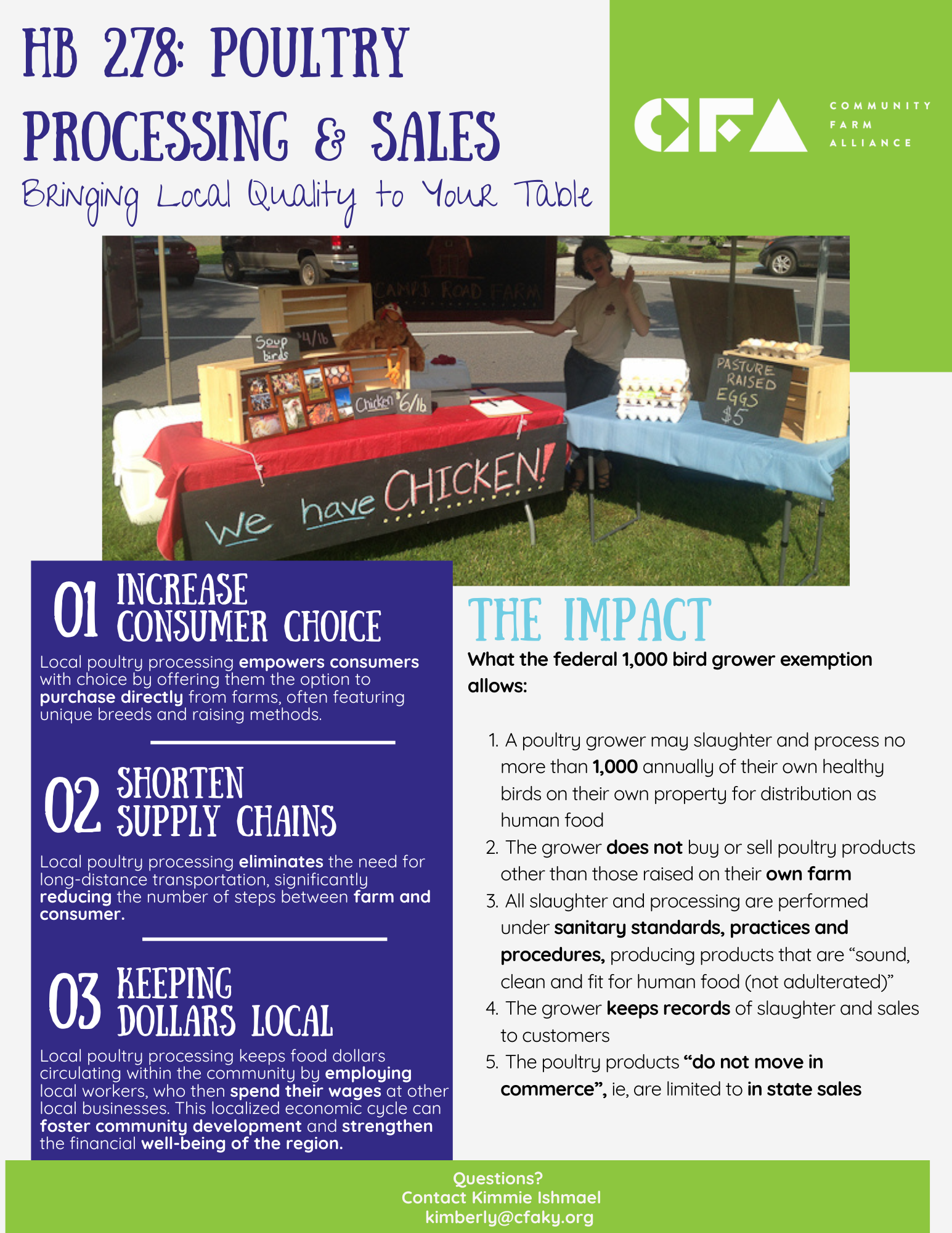
During the 2025 legislative session, HB 278 was introduced to address long-standing barriers facing small-scale poultry farmers. The bill proposed aligning Kentucky law with the federal 1,000-bird grower exemption, creating a clear and regulated pathway for limited on-farm poultry processing.

HB 278 passed through the Kentucky House with no opposing votes, a powerful demonstration of bipartisan support for Kentucky farmers, local food systems, and common-sense regulation.

Although the bill did not advance through the Senate due to legislative time constraints, its House passage marked a significant policy win. It confirmed that lawmakers across the political spectrum recognize both the need for reform and the strength of this solution.

The Policy Issue Remains

Federal law has allowed exemptions from continuous poultry inspection for small-scale producers since 1968, following amendments to the Poultry Products Inspection Act of 1957. These exemptions, outlined in 9 CFR 381.10, permit farmers to process a limited number of their own birds on-farm under specific conditions.

Despite this federal framework, Kentucky continues to impose unusually restrictive policies on poultry farmers operating under these exemptions. Kentucky currently has only three USDA poultry processors serving the entire state, creating a significant bottleneck for independent producers trying to access markets.

Limited processing capacity means long wait times, long-distance transport, increased costs, and added stress for both farmers and animals—challenges that existed long before the pandemic and were intensified by it.

What the Grower Exemption Allows

Under the federal 1,000-bird grower exemption:

  • Farmers may slaughter and process up to 1,000 healthy birds per year raised on their own farm.
  • Poultry products are sold directly to the end consumer only, with no resale.
  • All slaughter and processing must follow sanitary standards, practices, and procedures to ensure food safety.
  • Farmers must maintain records of slaughter and sales.
  • Products are limited to in-state sales and do not enter interstate commerce.

This exemption does not remove oversight. It removes the requirement for continuous on-site inspection while maintaining clear food safety expectations.

Why This Policy Matters

Expanding Farmers Choice
Allowing limited on-farm poultry processing increases the options that smaller farms have to process their birds. This means more time and money saved for our farmers

Expanding Consumer Choice
Allowing limited on-farm poultry processing increases access to locally raised poultry and gives consumers more direct connections to farmers and their food.

Strengthening Local Food Systems
Shorter supply chains reduce transportation distances and increase transparency, resilience, and reliability within Kentucky’s food system.

Keeping Food Dollars in Kentucky
Local processing keeps economic activity in local communities, supporting farm families, rural jobs, and small businesses.

Improving Animal Welfare and Product Quality
Reducing long-distance transport lowers stress on animals and helps preserve the quality of poultry products reaching consumers.

Kentucky’s Opportunity Moving Forward

Kentucky remains one of only two states that has not adopted the grower exemption. The passage of HB 278 in the House made clear that Kentucky is ready to change that.

This session, the policy will move forward again—under a new bill number—building directly on the foundation laid by HB 278. The goal remains the same: give farmers more options, support family farms, and expand access to safe, locally raised poultry.

Looking Ahead

HB 278 showed what is possible. With unanimous House support already behind this policy, Kentucky is closer than ever to meaningful poultry processing reform.

By advancing this policy under a new bill this session, the Commonwealth can:

  • Expand poultry processing options for farmers
  • Increase consumer choice
  • Strengthen local food systems
  • Keep food dollars circulating in local economies

Community Farm Alliance is continuing to work alongside farmers and legislators to ensure this policy crosses the finish line.

Questions?
Contact Kimmie Ishmael at kimberly@cfaky.org

Uncategorized

From Farm to Frankfort: How Policy Moves in Kentucky and What CFA Is Fighting For in 2026

The 2026 Kentucky General Assembly session begins January 6 and is scheduled to end on April 15. This 60-day session includes a veto period in late March and ends with “Sine Die” (the final day for any legislative action).

Want to follow a bill or speak up? Here’s a quick primer:

  • Bills must pass both the House and Senate and be signed by the Governor—or passed again after a veto.
  • The veto period (10 days) allows time for the Governor to review or reject bills before final adjournment.
  • Sine Die marks the end of the session. After this point, no new laws can be passed until 2027.

If you’re wondering how policy relates to your farm, this year’s CFA priorities highlight that connection clearly:

Important Legislative Dates 2026

CFA’s 2026 Legislative Priorities:

1. Poultry Processing Reform:
Allowing small poultry growers to use the federal 1,000-bird exemption for in-state sales. This helps shorten supply chains, reduce transport costs, and expand local markets.

2. Heirs Property Protections:
Advocating for full adoption of the Uniform Partition of Heirs Property Act (UPHPA) to help keep family land in family hands—especially in rural and Appalachian counties.

3. Soil Health Investment:
Pushing for a statewide Healthy Soils Program that offers technical assistance, conservation planning, and long-term productivity solutions for Kentucky’s farmers.

Want to see how it all fits together or share your story with legislators?


Watch the recorded webinar


And reach out to CFA to learn how to become an advocate for your farm and your community.