Uncategorized

Beyond the Farm: It Takes a Village

Farmers Markets are vital to creating healthy communities and supporting our farm economy. Adventure with us to the Berea Farmers Market where you will hear from Market Manager, Faye Adams-Eaton and Berea College Student, Gerald Thomas about how they support their local farmers. You will also see marketing strategies they used to increase their Kentucky Double Dollars participation.

Created by Elijah Manning, Madison County Community Ambassador

Uncategorized

Breaking Beans Radio Show #27: Eastern Kentucky Technical Support Professionals

Aired: April 4, 2018


In this episode of Breaking Beans, Sister Kathy travels to speak with three men who are working to help eastern Kentucky farmers and growers do their work better.

First she goes to Berea Kentucky to talk to Chris McKenzie of Grow Appalachia. They discuss the newest Grow Appalachia program, D.I.G.S. Then she visits the Robinson Center in Jackson to talk to Kevin Gurtowski, Agriculture Extension agent with Kentucky State University, to hear about KSU’s Small Farm grant among other things. Lastly, she wraps up the show in Letcher County at Tylers’ Plant Place talking to David Tyler about going from coal trucks to greenhouses and the Turkey Creek Tomato. It’s a great look into the behind the scenes action in Eastern Kentucky farming. 


Find other episodes and Breaking Beans stories here:

http://cfaky.org/blog

Download this and other past episodes here:

https://archive.org/details/@breakingbeans

The Breaking Beans Variety Radio Show airs on 88.7 WMMT (online too!) the first Wednesday of every month at 6pm featuring stories, interviews, recipes, and news from the food and farming worlds in the Appalachian region!

Hosted by Breaking Beans Fellow Sister Kathy Curtis.


breakingbeansWEBsm


Breaking Beans: The Appalachian Food Story Project is an initiative of Community Farm Alliance to tell the story of how local food and farming in Eastern Kentucky can contribute to a bright future in the mountains. Eastern Kentucky is at the point where it can foster a food system that is equitable and accessible to all, provides fresh nutritious food, and serves as an economic generator that builds community wealth. With a rich history of food and farming, stories of how Eastern Kentucky is already growing in that direction – and the challenges along the way – are important for informing people and policy alike.

Uncategorized

Hungry in the Land of Milk and Honey

By Sister Kathy Curtis

Born and raised in Richmond Kentucky, Alisha Mays grew up hungry. “There were many days that all we had to eat was Totino’s pizza rolls drenched in ranch dressing,” she told a group attending the recent Hunger Dialogue gathering at Berea College. Alisha and I were part of a breakout session led by Dr. Nicole Breazeale, Associate Professor of Sociology at Western Kentucky University. The session was on storytelling and the positive impact telling one’s own hunger story can have on social change. Alisha told us what it was like to grow up in poor and hunger.

While the bulk of her story is hers to tell, I can tell you that Alisha, a graduate of Eastern Kentucky University, is currently working on her master’s degree with Dr. Breazeale at WKU in Glasgow. Her theme is self-provisioning in eastern Kentucky with a special emphasis on the social relationship that exists around home gardening. She explained that self-provisioning includes things like hunting, fishing, foraging and most relevant for her purposes, growing a vegetable garden.

Alisha and I first met when she came to Floyd County to meet families who were growing home vegetable gardens. She spent two months sitting on people’s porches and hearing their stories. During the Hunger Dialogue gathering she told of one of her last days in eastern Kentucky before heading back to Bowling Green.

It was August and Alisha was visiting a family that had befriended her while she was in Floyd County,“It was pouring the rain and because I don’t do so good at driving holler roads in the rain, I was sitting on the porch waiting for it to stop. I looked around me at all the corn and the tomatoes. There was a garden in front and another big garden next to that; the neighbors had a garden too. All around me was food!   [As a child] I remembered hearing a stat once that food has to travel 1400 miles to get to your plate and I remembered thinking “Yes!” because there isn’t enough in the world to feed everybody and that’s why I am hungry.” Talking about her time in Floyd County, Alisha went on to say “I have never seen so much food in my life. I have been in grocery stores but this was different.”

By listening to their stories, Alisha had built a relationship with the family she was visiting and she knew that if she were hungry they would be totally fine with her picking some corn or digging potatoes. Those of us who live in the mountains know this to be true. Care of family and neighbor is ingrained in Appalachian people. In an east Kentucky holler, Alisha experienced a food system built on relationships. Unfortunately, that system does not translate well in our current culture.

Kentucky’s food system is broken, especially for those who live in chronic poverty. Even here in the mountains, too few people know how to grow and preserve food for their families even if they have the land and the physical ability to grow it themselves. Too little healthy food is found at regional food pantries. Few and far between are green spaces where people can grow even some of their food needs. But, there are signs here in Kentucky that this situation is changing.

For example, Berea College’s Grow Appalachia program is, the largest home gardening program in the United States, helps families meet their food needs by providing hands-on training and resources. Grow Appalachia currently works with “communities in six states throughout central Appalachia.” Their mission is, “working to combat food insecurity and malnutrition”. Grow Appalachia and its partners have worked directly with more than 4,300 families to produce nearly three million pounds of healthy, organic produce.”

Another example is In an effort to reduce food waste and meet the needs of both Kentucky farmers and hungry citizens, the Kentucky Association of Food Banks (KAFB) has developed its Farms to Food Banks Program. According to its website in 2016 the Farm to Food Banks Program benefitted hungry Kentuckian in all 120 counties. 385 Kentucky farmers from 67 counties were paid an average of $2000 for their surplus and second grade produce. And the KAFB, through their seven-member food banks and 520 partner agencies, distributed 3,110,600 pounds of fresh produce that otherwise would have been plowed under.

And finally, in the spring of 2016 Kentucky Agriculture Commissioner Ryan Quarles launched the  Kentucky Hunger Initiative. The first-of-its-kind effort in Kentucky brings together farmers, charitable organizations, faith groups, community leaders, and government entities to help reduce hunger in Kentucky. Commissioner Quarles has made reducing hunger, in both the rural and urban parts of Kentucky, a major priority during his time in office.

With input directly through community, the Kentucky Hunger Initiative task force has developed three goals to address Kentucky’s growing hunger problem:

Goal 1: Build and expand collaborative partnerships between the public and private sectors that will minimize hunger in Kentucky.

Goal 2: Strengthen Kentucky’s food-distribution infrastructure to enable farmers to better serve the needs of Kentuckians.

Goal 3: Increase education and public awareness of hunger that affects Kentuckians of all ages.

Right about now you may be wondering why I even bring these statistics and organizations up. After all, Breaking Beans is about telling the story of farming and the local food system in eastern Kentucky. Well, I used to say that food system work is collaborative work because, “everybody eats”. But after hearing Alisha’s story, I realize that is not true. According to the Kentucky Association of Food Banks, “Over 700,000 Kentuckians, or 1 in 6, do not always know where their next meal will come from. More than 1 in 5 of Kentucky’s children lack consistent access to enough food for a healthy, active lifestyle.”

Hunger persists in Kentucky because it remains faceless. That’s why Alisha’s story is so important, and far too common. In a state that has the agricultural heritage that Kentucky has, that is unacceptable.

If you feel the same, here are some ways that you can help.

  • Start in your own community by finding out what your local food pantry needs and get it for them. Most of them need volunteers more than they need food. Check the Kentucky Association of Food Banks website for a pantry near you.
  • Start a home or community garden and share with your friends and neighbors. Grow Appalachia is a great place to start.
  • Join Community Farm Alliance. Our Vision is a food system that provides nutritious food for Kentuckians in a manner that is socially, economically, and ecologically sustainable. We envision a system vital to the state’s economy.
  • Write your own hunger story and tell it. The only shameful thing about hunger in our country is that it still exists.

Imagine sitting on the front porch of a house at the head of the holler surrounded by corn, beans, tomatoes and okra and thinking, “Isn’t it wonderful we live in a place where good food is accessible to all.”

Fiber Podcast

Fiber Podcast #2: Alpaca, Fiber Farming, and the Emerging Slow Fashion Movement

Posted: July 12, 2017

Hosted and written by Appalachian Transition Fellow, Sam Hamlin

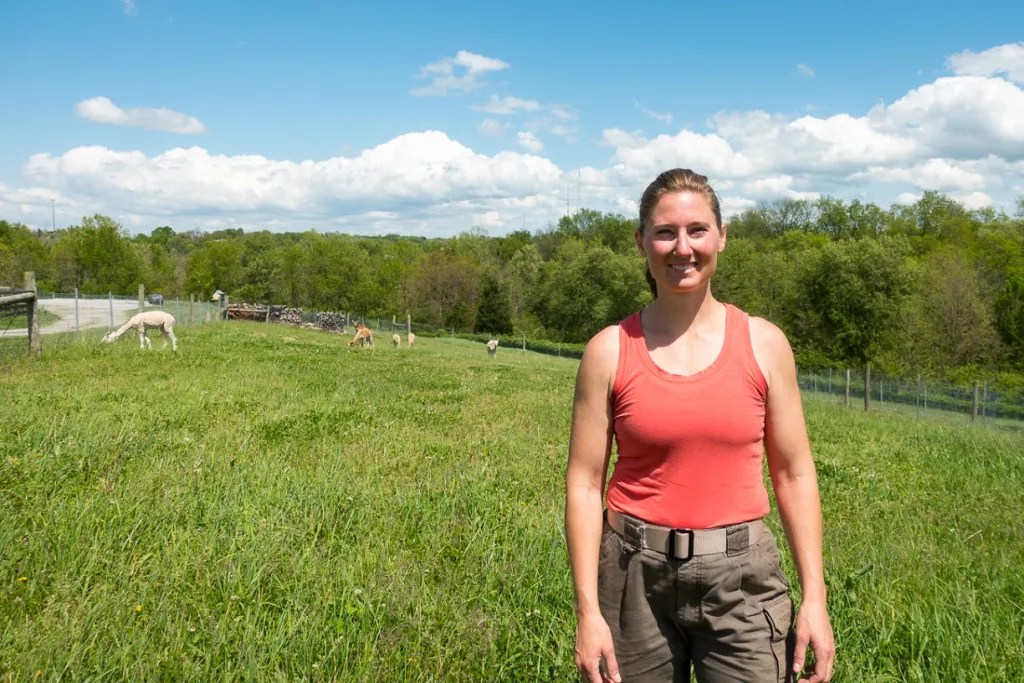
In late April, I traveled with my colleague, Appalachian Transition Fellow, Hope Hart to Alvina Maynard’s alpaca ranch just outside of Richmond, Kentucky. We were ready to learn more about alpacas, fiber farming, and Alvina’s perspective on how to grow the natural fiber sector in Kentucky. After winding through a curvy, tree-covered road we came upon the beautiful green rolling hills of River Hill Ranch, where Alvina raises anywhere from 75 to 100 alpacas, depending on the time of year. We sat down with Alvina on a sunny, 83 degree, April day to interview her for CFA’s first ever Breaking Beans Fiber podcast.

Alvina explained to us that she started alpaca farming through a combination of her love of the outdoors, inspiration from other veteran-turned-farmers, and by following her calling. “I wanted a space that provided genuine connection; to experience both adventure and tranquility at the same time. So, alpacas…not only are they quiet animals but they’re relatively small livestock, they’re easy to manage, they have padded feet instead of hooves, so all of those aspects appeal to having children around.”

First named as official livestock in the 2008 Farm Bill, alpaca farming is a relatively new in the U.S. As a growing sector, there are lots of opportunities for new farmers and entrepreneurs to explore this unique industry. Alpaca are non-aggressive, curious animals who produce an incredibly soft fleece that can be used to make sweaters, socks, hats, mittens, and much more.

Each April, Alvina completes an annual alpaca shearing at River Hill Ranch. She sorts through each fleece and determines its quality and She sells to a variety of processors on different scales, all who transform raw fleece into yarn and sometimes into value-added (or finished) products, such as socks and hats.  Alpacas are multi-purpose animals: on the River Hill Ranch website, you can find beautiful alpaca shawls, gloves, hats, headbands, boot inserts and more for purchase. In addition to fiber products, Alvina also sells alpaca meat. Alvina explained that alpaca meat “tastes like sweet version of beef, but with the texture of tuna. We want to make sure nothing goes to waste.” You can visit Good Foods Co-op in Lexington, as well as Game, a restaurant in Louisville to purchase some for yourself. You can find all of Alvina’s products at the Richmond and Lexington farmer’s market in the summers or year-round on the River Hill Ranch website.

During our time with Alvina on River Hill Ranch, we had the opportunity to learn about a variety of fascinating topics related to alpaca farming: from grass management, to silvopasturing, to the exciting possibilities of using plants, such as pokeberry and goldenrod, as natural dyes for textiles. We even had the opportunity to assist Alvina in herding her female alpacas across the pasture by moving electric fencing and putting my four-wheel drive to good use going up and down the rolling hills of her ranch.

But, perhaps the most exciting part of the day was getting to talk with Alvina about her vision for the larger natural fiber and slow clothes movement. Alvina shared that, “caring for the world starts with caring for the earth and I am super excited to be a part of this. It found me. And this is a way that we can impact positive change in going forward by bringing that awareness to our relationship to our clothes and how that impacts our planet. I’m at farmers market and still a lot of people look at me with confusion in their eyes….because not a lot of people understand where their clothes come from.”

As I have embarked on my current project mapping the natural fiber sector, I have noticed the confusion that sometimes appears on people’s faces as I tell them that I work for a farmer advocacy organization. Due to the rise of synthetic fibers and throw-away consumer culture, most of us don’t have knowledge about where our clothes come from or what kinds of labor went into making them. In our interview, Alvina pointed out that “the fashion industry has made it so that they want us back in the store every three to six weeks. And so clothes have become disposable, because synthetic fibers are cheaper, they’re made predominately by synthetics, which are plastic. They’re not biodegradable. So not only have we increased our consumption rate of clothing, but we’ve also made them out of a non-biodegradable substance that is going into a landfill. This return to natural fibers coming back around to being mainstream is going to be a huge environmental impact.”

The slow fashion movement, is gaining traction as many people are becoming more conscious about the environmental and human impact of the current global textile production system. Slow fashion advocates and farmers, like Alvina, are leading the way in reviving the natural fiber textile sector in Kentucky, and beyond. “Change will really happen in our society, when it is driven more by demand” Alvina pointed out. “Not a lot of people understand where their clothes come from or what they’re even made out of…In recent history, the slow food movement has seen a lot of success where it has brought that awareness mainstream, where people are asking questions now of where their food comes from, what’s in their food, and what went into making, growing, processing their food…So I’m really excited that the slow fashion and slow clothes movement is also starting to gain traction, and people are starting to ask those questions now, where their clothes come from.”

For more from Alvina, make sure to listen to our extended interview that includes more stories about fiber farming, alpaca, and the local clothes movement. You can find out more about River Hill Ranch on their website, Facebook and Instagram pages.

To keep up with Community Farm Alliance’s natural fiber sector mapping project, check out our website and Facebook page or sign up for our CFA’s monthly newsletters by becoming a member.

Lastly, be on the look out for opportunities to support your local fiber farmer at your farmers market and on our blog in the coming months.

Uncategorized

Fiber Podcast #1: Stories from the Field

Posted: May 16, 2016

On our first Breaking Beans podcast on natural fiber systems, CFA Fellow Sam Hamlin interviews alpaca farmer, Alvina Maynard, sheep farmer, Kathy Meyer, and fiber mill owner, Ed Crowley. Pictures courtesy of Hope Hart, Appalachian Transition Fellow with Appalshop. In the next few weeks we will be releasing more in depth one on one interviews with some of the folks featured in this podcast, so stay tuned!

Alvina Maynard is an alpaca farmer in Richmond, Kentucky. In this episode, Alvina talks with Sam about why she became an alpaca farmer, visions for the Kentucky natural fiber sector, and the innovative work that she does on her farm, River Hill Ranch.


Kathy Meyer owns Final Frontier Farm, a sheep farm in beautiful Paris, Kentucky. Kathy talks with Sam about how she got into sheep farming, discovering the value of her wool, and about the upcoming Kentucky Sheep and Fiber Festival, May 20-21 in Lexington.


Ed Crowley is a sheep farmer in Versailles, Kentucky who is opening a new fiber processing mill in early summer, 2017. He talks with Sam about what makes Crowley’s Mill unique and about how it could change the natural fiber sector landscape in Kentucky.

Find other episodes and Breaking Beans stories here:

http://cfaky.org/blog

Download this and other past episodes here:

https://archive.org/details/@breakingbeans


breakingbeansWEBsm

Breaking Beans: The Appalachian Food Story Project is an initiative of Community Farm Alliance to tell the story of how local food and farming in Eastern Kentucky can contribute to a bright future in the mountains. Eastern Kentucky is at the point where it can foster a food system that is equitable and accessible to all, provides fresh nutritious food, and serves as an economic generator that builds community wealth. With a rich history of food and farming, stories of how Eastern Kentucky is already growing in that direction – and the challenges along the way – are important for informing people and policy alike.